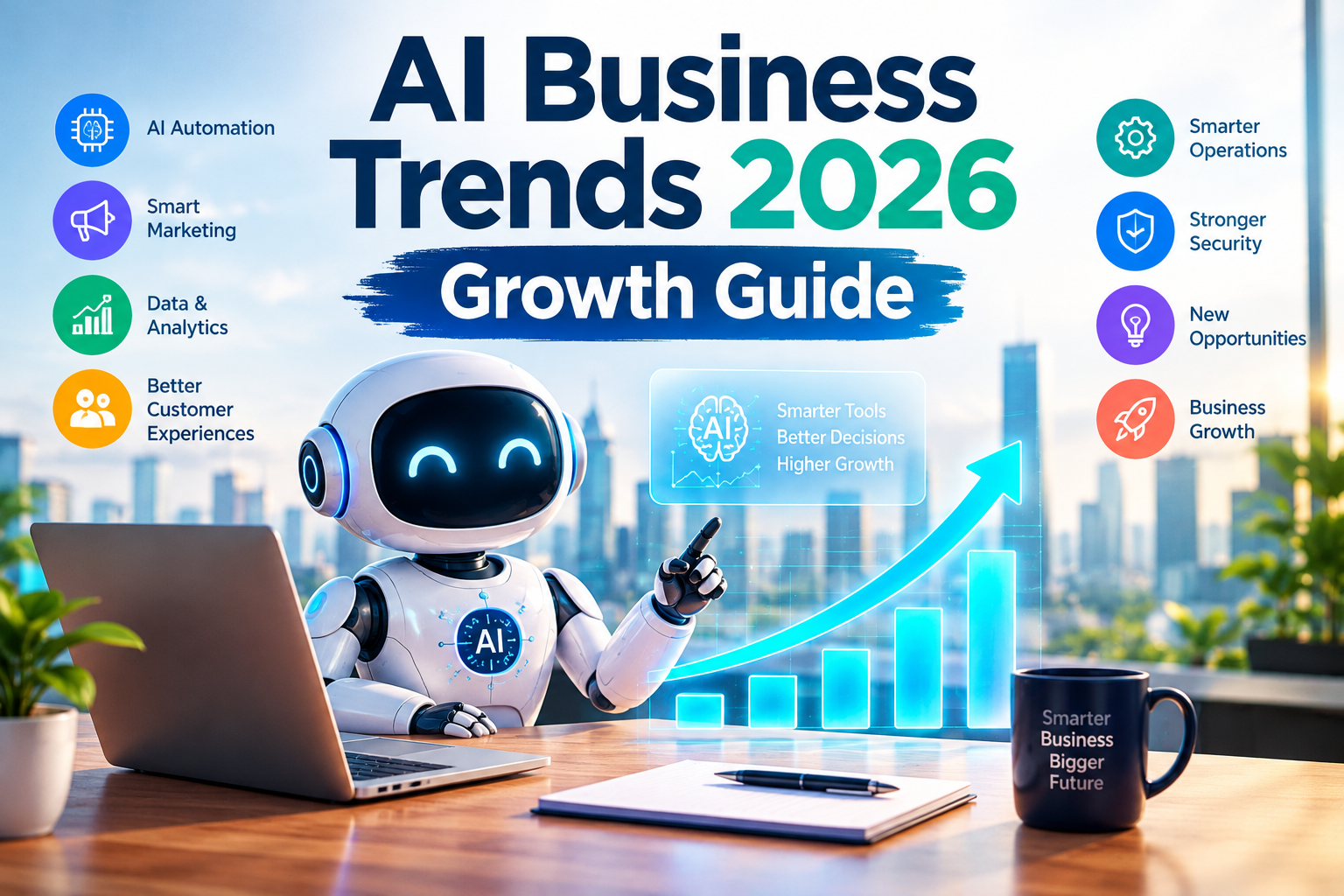
AI Business Trends 2026 are changing how companies operate, communicate with customers, manage employees, and compete in digital markets. Artificial intelligence is no longer limited to large technology companies. Small businesses, online stores, marketing agencies, and independent entrepreneurs are also exploring AI tools to improve productivity and support business growth. These developments create new opportunities for companies that want to work more efficiently, understand customer needs, and make better decisions.
The growing interest in AI Business Trends 2026 reflects a wider shift toward smarter business operations. Companies are using artificial intelligence for content creation, customer support, data analysis, marketing, and routine administrative tasks. However, adopting AI does not automatically guarantee success. Businesses need clear goals, suitable tools, reliable information, and responsible implementation to achieve meaningful results. Understanding the latest developments can help business owners identify practical opportunities and prepare for future challenges.
What Are AI Business Trends 2026?
AI Business Trends 2026 refer to the emerging ways organizations use artificial intelligence to improve their daily operations and long-term strategies. These trends include generative AI, intelligent automation, AI-powered marketing, customer service assistants, predictive analytics, and personalized digital experiences. Each development offers different benefits depending on a company’s size, industry, budget, and objectives.
One important development is the movement from experimenting with AI to integrating it into regular business activities. Instead of using AI occasionally to generate ideas, companies are beginning to connect AI capabilities with established workflows. For example, a small retailer might use AI to prepare product descriptions, analyze customer feedback, and draft promotional emails. A consulting business might use it to organize research, summarize documents, and prepare initial reports.
The 2026 technology landscape also highlights the importance of practical implementation. The 2026 Empowering Small Business Report from the U.S. Chamber of Commerce examines how technology adoption is affecting small businesses. Its findings underline the growing role of AI and digital platforms in business operations. For companies exploring AI Business Trends 2026, the main lesson is to focus on tools that solve real problems instead of adopting technology simply because it is popular.
Generative AI Is Transforming Business Productivity
Generative AI remains one of the most important AI Business Trends 2026 because it can help businesses produce and organize different types of content. Depending on the tool, businesses can generate written drafts, brainstorm product ideas, summarize documents, create visual concepts, and develop outlines for marketing campaigns. These capabilities can reduce the time required for repetitive creative work.
Small businesses can benefit significantly from these applications. A business owner who manages sales, marketing, and customer communication without a large team may use AI to prepare email drafts, develop website content, and organize frequently asked questions. This support can free up time for activities that require personal attention, such as building customer relationships and improving products.
However, generative AI should support human expertise rather than replace careful judgment. AI-generated information may contain factual errors, outdated details, or unsuitable recommendations. Businesses should review important content before publishing it or sharing it with customers. Financial statements, legal documents, product claims, and technical instructions deserve particular attention.
Successful AI Business Trends 2026 strategies combine automation with human review. Companies that establish clear editing standards can benefit from faster content production while protecting accuracy and brand reputation. The objective is not to publish more material without consideration, but to create useful, trustworthy content more efficiently.
AI Automation Is Improving Daily Operations
Business automation is another major development shaping AI Business Trends 2026. Traditional automation follows predefined rules, while AI-enabled systems can assist with tasks involving language, classification, pattern recognition, and information extraction. When implemented appropriately, these capabilities can help organizations reduce repetitive work and manage growing workloads.
For example, an online store may use automation to categorize customer questions, organize incoming orders, and identify messages that require human attention. A service provider might automate appointment reminders and initial customer inquiries. An accounting team could use suitable software to extract information from documents before a professional reviews the results.
These applications can improve consistency and reduce the time employees spend on routine activities. Nevertheless, businesses should examine their existing processes before introducing automation. Automating an inefficient process may simply make the same problem happen faster.
A practical approach begins with identifying repetitive tasks that consume significant time. Business owners can then evaluate whether an AI tool can handle part of the workload safely and accurately. After a small trial, they should compare the results with the original process and expand its use only when the benefits are clear.
AI Business Trends 2026 increasingly encourage businesses to treat automation as an operational improvement rather than a technology experiment. Clear responsibilities, reliable systems, and regular performance checks remain essential for long-term success.
AI-Powered Marketing Is Becoming More Practical
Digital marketing is one of the areas where AI Business Trends 2026 can offer practical advantages. Marketing teams must understand customer interests, prepare relevant messages, analyze campaign results, and adjust their strategies as market conditions change. AI tools can assist with several of these activities by organizing information and helping marketers explore different approaches.
Businesses can use AI to brainstorm campaign ideas, create initial advertisement drafts, develop audience research questions, and summarize customer feedback. These capabilities may be particularly useful for small companies that cannot afford a large marketing department. A local business, for instance, can use AI to plan seasonal promotions and draft social media content while keeping its communication consistent.
AI can also support search engine optimization by helping marketers identify related topics, organize article outlines, and improve content structure. However, search visibility depends on much more than AI-generated text. Content must satisfy search intent, provide original value, demonstrate appropriate expertise, and offer a positive experience to readers.
Companies should avoid publishing large quantities of generic pages simply to target more keywords. Instead, AI Business Trends 2026 should encourage a more thoughtful approach in which technology supports research, planning, and editing. Human insight remains important for understanding customers and creating distinctive brand messages.
Businesses should also measure marketing performance instead of assuming that AI-generated campaigns will automatically improve results. Engagement, qualified leads, conversion rates, customer retention, and revenue can help determine whether a particular strategy is effective.
Personalized Customer Experiences Through AI
Customer expectations continue to influence the direction of AI Business Trends 2026. Many consumers expect businesses to provide relevant information, timely responses, and convenient support. AI can help organizations deliver more personalized experiences when they have appropriate data and clear privacy practices.
For example, an online retailer may recommend products based on a customer’s previous purchases or stated interests. A service company may use customer relationship management software to organize communication histories and prepare more relevant follow-up messages. A support assistant may help visitors find answers to common questions without waiting for an employee.
Personalization can improve convenience, but it must be handled carefully. Businesses should avoid collecting unnecessary personal information or making customers feel that their activities are being monitored without a clear reason. Data should be managed according to applicable privacy requirements, and customers should have access to human assistance when automated systems cannot resolve their problems.
Another important consideration is transparency. Customers should understand when they are interacting with an AI assistant, particularly when the conversation involves sensitive information, payments, or important business decisions.
The most effective AI Business Trends 2026 strategies combine speed with genuine customer care. AI can help businesses respond efficiently, while trained employees handle complex complaints, unusual requests, and situations requiring empathy or professional judgment.
Predictive Analytics and Smarter Business Decisions
Predictive analytics is becoming an important part of AI Business Trends 2026 because businesses need reliable information to make decisions about inventory, staffing, sales, and future investment. AI-powered analytical tools can examine historical information, identify patterns, and generate forecasts that support planning.
A retailer might analyze previous sales to estimate demand for particular products. A manufacturer could examine production information to identify potential delays. A service provider might review customer inquiries to understand which services attract the most interest. These insights can help managers prepare for changing conditions rather than relying entirely on intuition.
However, forecasts are not guarantees. Results depend on the quality, relevance, and completeness of the available information. Unexpected events, economic changes, new competitors, and shifts in customer preferences can make previous patterns less useful.
Businesses should therefore use AI-generated forecasts alongside industry knowledge and professional judgment. Important decisions should consider several possible outcomes rather than relying on a single prediction.
AI Business Trends 2026 also make data quality increasingly important. Companies should maintain accurate records, correct inconsistent information, and establish appropriate access controls. Better data practices can improve the usefulness of analytical tools while reducing the risk of misleading conclusions.
AI Agents and Connected Business Workflows
AI agents are attracting attention because they can be designed to perform sequences of tasks rather than responding only to individual requests. Depending on their configuration and permissions, these systems may help gather information, prepare summaries, update approved records, or coordinate steps within a workflow.
For example, a business might configure an assistant to collect information from approved sources, prepare a draft report, and send it to an employee for review. Another system could help organize incoming sales inquiries and suggest appropriate next steps. These applications may reduce the need for employees to move manually between different software tools.
Nevertheless, more autonomy creates additional risks. An AI agent could misunderstand an instruction, use incomplete information, or perform an inappropriate action if its permissions are too broad. Businesses should establish limits on what an agent can access and which actions it can complete without approval.
Sensitive operations involving money transfers, confidential information, employment decisions, or contractual commitments should receive appropriate human oversight. Testing should also cover unusual situations rather than only normal tasks.
Among AI Business Trends 2026, AI agents represent an opportunity to connect separate activities into more coordinated workflows. Their value depends on dependable performance, clear instructions, secure integrations, and effective supervision.
Cybersecurity and Responsible AI Adoption
As businesses introduce more AI tools, cybersecurity and data protection become increasingly important. Employees may use online AI services to summarize documents, draft messages, or analyze information without fully understanding how their data is handled. Sharing confidential business records with an unapproved tool can create unnecessary risks.
Responsible AI adoption should begin with a clear policy explaining which tools employees may use, what information they can share, and which activities require approval. Businesses should evaluate vendors’ security practices, privacy policies, data retention rules, and access controls before using their services for sensitive work.
Employee training is equally important. Staff members should learn to recognize unreliable outputs, protect customer information, identify suspicious requests, and report potential security problems. Companies should also maintain suitable backup procedures and review user permissions regularly.
Another concern is the accuracy of AI-generated information. Incorrect outputs may lead to misleading marketing claims, poor financial decisions, or inappropriate customer responses. Human review, testing, and documented approval procedures can reduce these risks.
The OECD’s 2026 report on empowering small and medium-sized enterprises in the age of AI discusses AI adoption, business opportunities, and barriers such as skills gaps, implementation costs, and cybersecurity challenges.
These issues show why AI Business Trends 2026 should not focus on innovation alone. Responsible implementation helps businesses protect customers, maintain trust, and build technology practices that can support long-term growth.
AI Business Trends 2026 for Small Businesses
Small businesses often have limited budgets, small teams, and competing operational priorities. AI can help address some of these challenges by making certain tools and capabilities more accessible. However, a small company does not need to adopt every available technology to remain competitive.
The best starting point is a specific business problem. An online seller might need better product descriptions, while a consultancy may want to reduce time spent preparing meeting summaries. A local service provider might benefit more from appointment scheduling and customer communication than from advanced predictive analytics.
Business owners should compare available tools based on ease of use, reliability, privacy, integration options, and total cost. Free plans can be useful for initial testing, but companies should examine usage limits and commercial terms before depending on them for important operations.
Employees also need time to learn new systems. Short training sessions, simple instructions, and practical examples can make adoption easier. Managers should invite feedback from the people who use the tools every day because they often understand operational problems better than anyone else.
AI Business Trends 2026 offer small companies a chance to improve selected activities without building expensive systems from scratch. The strongest results are likely to come from focused experimentation, careful measurement, and gradual expansion.
How to Build an Effective AI Business Strategy
A successful AI strategy begins with business objectives rather than technology. Before purchasing software, leaders should identify what they want to improve. Common goals include reducing administrative work, responding to customers faster, improving marketing efficiency, or gaining clearer insight into sales performance.
The next step is to examine existing workflows and identify tasks suitable for AI assistance. Activities that are repetitive, time-consuming, and easy to review can be good candidates for an initial trial. High-risk decisions should receive more careful evaluation and stronger human supervision.
Businesses should then establish a baseline for measuring performance. For example, they can record how long a task currently takes, how often errors occur, and how much the process costs. After introducing an AI tool, they can compare the results against those measurements.
Cost evaluation should include more than the subscription price. Training, setup, integration, maintenance, employee review, and potential errors can also affect the total investment. A tool that appears inexpensive may not provide good value if it requires extensive manual correction.
Finally, businesses should review the results regularly. Successful applications can be expanded, while tools that fail to deliver meaningful benefits can be adjusted or discontinued. This measured approach helps organizations turn AI Business Trends 2026 into a practical business strategy instead of an expensive collection of unused software.
Read more about: blog whatutalkingboutwillis
Challenges Businesses Should Consider
Despite its potential, artificial intelligence introduces challenges that companies must understand. One major concern is the reliability of generated information. AI systems can produce convincing answers that are incomplete or incorrect, so important outputs need verification.
Implementation costs are another consideration. Businesses may face subscription fees, training requirements, integration expenses, and additional security responsibilities. Smaller organizations should prioritize solutions that address clear operational needs and fit their available budgets.
Employee confidence can also influence adoption. Some workers may worry about job security, while others may feel uncertain about using unfamiliar systems. Open communication and appropriate training can help employees understand how AI supports their work and where human skills remain essential.
Legal and ethical responsibilities also matter. Businesses should review relevant privacy, consumer protection, intellectual property, and industry-specific requirements before deploying AI in sensitive areas. Requirements vary by jurisdiction and application, so professional advice may be appropriate when risks are significant.
Another challenge is overdependence on a single provider. If an essential service changes its pricing, features, or availability, business operations may be affected. Companies should consider data portability, alternative processes, and backup arrangements when selecting important tools.
Understanding these challenges allows organizations to adopt AI Business Trends 2026 more confidently. Careful planning cannot remove every risk, but it can make technology decisions more informed and sustainable.
The Future of AI Business Trends 2026
The future of AI in business will likely involve deeper integration between intelligent tools and everyday software. Marketing platforms, customer relationship systems, accounting applications, and project management services are increasingly exploring AI-assisted features. This may make advanced capabilities more accessible to organizations that lack dedicated technical teams.
Another likely development is a stronger focus on measurable business value. As companies gain experience with AI, they may pay closer attention to whether tools improve productivity, customer satisfaction, accuracy, or profitability. Demonstrating clear results will become more important than simply announcing that a business uses artificial intelligence.
Human skills will remain essential. Communication, creativity, leadership, ethical judgment, and relationship building cannot be reduced to choosing the right software. Businesses that combine these capabilities with useful AI applications may be better positioned to adapt to changing customer expectations.
AI Business Trends 2026 should therefore be viewed as an evolving set of opportunities rather than a guaranteed path to success. Companies that learn continuously, protect their information, and make decisions based on evidence can prepare for further technological changes.
Conclusion
AI Business Trends 2026 are creating new ways for businesses to improve productivity, strengthen customer relationships, automate routine work, and make more informed decisions. Generative AI, intelligent automation, predictive analytics, AI agents, and personalized marketing each offer practical opportunities when applied to the right problems.
However, successful adoption requires more than selecting popular tools. Businesses must consider costs, employee training, data security, accuracy, and customer trust. Starting with clear objectives, testing solutions carefully, and measuring results can help organizations avoid unnecessary expenses.
The most effective approach to AI Business Trends 2026 is to combine technological innovation with human judgment. Businesses that adopt AI responsibly and focus on genuine customer and operational needs can build a stronger foundation for sustainable growth.