Introduction
The outsourcing and customer support industry has changed rapidly in recent years. Businesses are now expected to provide faster responses, better customer experiences, improved communication, and reliable support across different locations and time zones. As organizations grow, managing employees, schedules, workloads, customer interactions, and operational performance becomes increasingly complex.
This is where terms such as Timewarp TaskUs attract attention online.
People searching for Timewarp TaskUs may be looking for information related to time management, workforce operations, productivity, scheduling, customer support technology, automation, or internal systems associated with a large business-process outsourcing environment.
However, it is important to understand the term carefully. Timewarp TaskUs should not automatically be treated as the name of a publicly confirmed standalone software product unless an official source specifically verifies that claim. Instead, the term can be discussed in the broader context of modern workforce management, time tracking, workflow optimization, digital customer support, and automation.
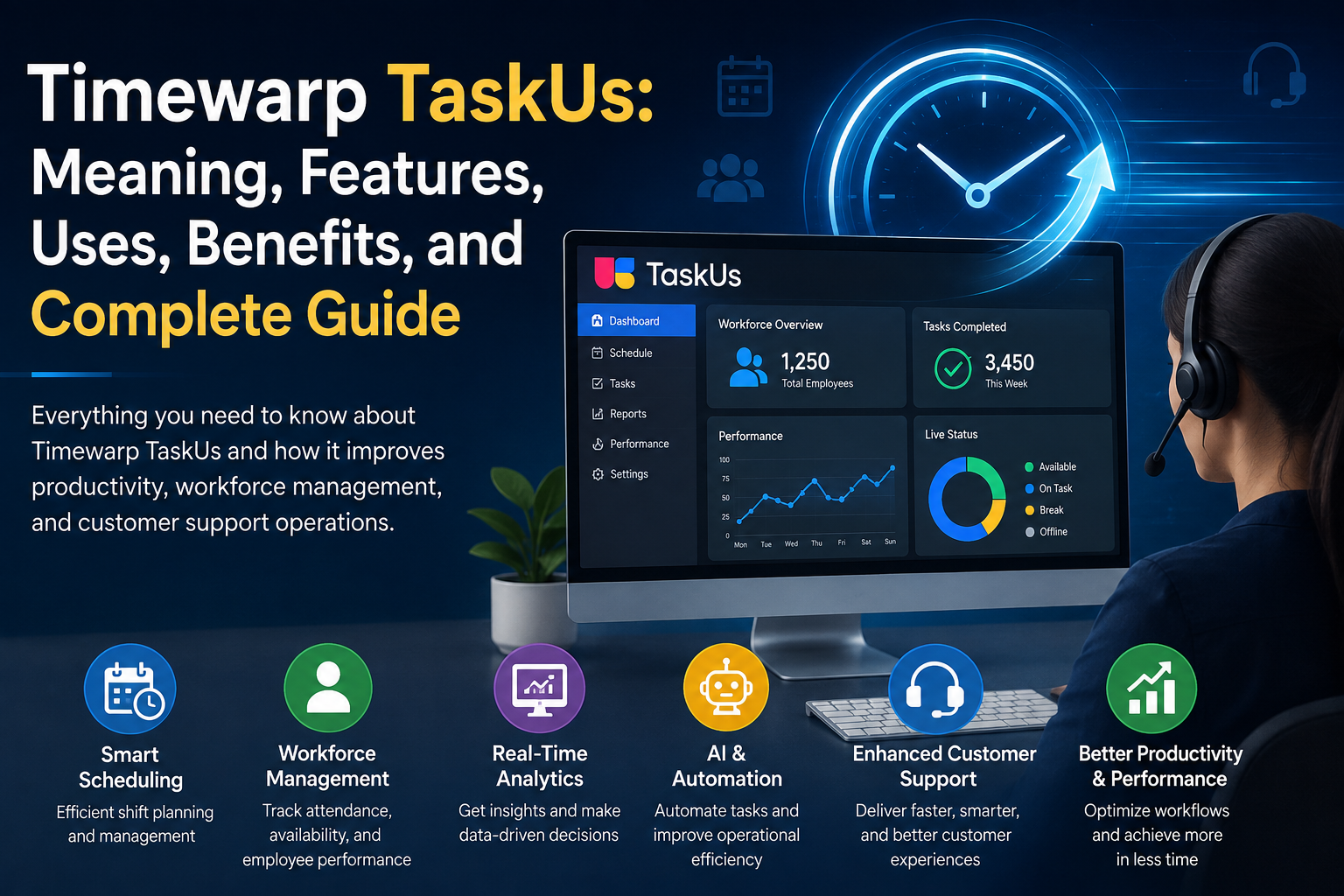
This complete guide explains the possible meaning of Timewarp TaskUs, how similar systems work, their features, potential benefits, challenges, and their possible role in the future of outsourcing and digital operations.
What Is Timewarp TaskUs?
Timewarp TaskUs is a keyword and phrase that appears to be connected with discussions about TaskUs-related operations, workforce productivity, scheduling, time management, and customer support technology.
The phrase combines two ideas:
- Timewarp may suggest speed, time optimization, scheduling, tracking, or workflow efficiency.
- TaskUs is associated with the business-process outsourcing and digital services industry.
When people search for Timewarp TaskUs, they may be trying to understand an internal tool, workflow concept, time-management system, employee platform, productivity process, or technology-related discussion connected to large-scale customer support operations.
Because modern outsourcing organizations manage large workforces, they often rely on different types of digital systems. These can include tools for:
- Workforce scheduling
- Attendance management
- Performance reporting
- Task allocation
- Customer support operations
- Workflow monitoring
- Data analysis
- Automation
- Communication
- Productivity measurement
Therefore, Timewarp TaskUs can be understood as a phrase connected to the broader idea of making time, work, and operations more organized and efficient.
Understanding the Meaning of Timewarp in a Business Environment
The word Timewarp naturally creates an image of moving through time faster. In a business environment, however, the concept can be understood differently.
Businesses are always searching for ways to complete work more efficiently. They want to reduce unnecessary delays, avoid repetitive tasks, organize employee schedules, and improve the speed of customer service.
A Timewarp-style approach to operations may focus on questions such as:
- How can work be completed faster?
- How can employee time be managed effectively?
- How can scheduling conflicts be reduced?
- How can repetitive tasks be automated?
- How can managers understand operational performance?
- How can customer requests be handled more efficiently?
The goal is not simply to make employees work faster. A modern productivity system should help organizations work smarter by improving planning, reducing unnecessary administrative work, and providing better visibility into operations.
This idea is especially important in large outsourcing environments where thousands of customer interactions may take place every day.
The Connection Between Timewarp TaskUs and Workforce Management
One of the most useful ways to understand Timewarp TaskUs is through the concept of workforce management.
Workforce management refers to the process of organizing people and resources so that a business can operate efficiently. In customer support and outsourcing environments, workforce management can involve many responsibilities.
These may include:
Shift Scheduling
Employees may work during different hours depending on customer demand, business location, and international time zones.
A scheduling system can help managers organize:
- Morning shifts
- Evening shifts
- Overnight support
- Remote work schedules
- Peak-hour coverage
- Leave planning
Proper scheduling can reduce confusion and help ensure that enough employees are available when customer demand increases.
Attendance Tracking
Organizations need accurate information about employee attendance and working hours.
Digital systems may help record:
- Start times
- End times
- Break periods
- Shift attendance
- Schedule changes
The purpose should be accurate operational management rather than unnecessary complexity.
Workload Distribution
Customer support teams may receive different numbers of requests throughout the day.
A large increase in customer inquiries can create pressure on employees. Workload management systems can help organizations understand where additional resources may be needed.
For example, one support department may receive fewer requests while another experiences a sudden increase in customer messages. Managers can then review staffing requirements and make appropriate adjustments.
Performance Reporting
Modern digital systems can generate reports that help managers understand operational activity.
Reports may provide insights into areas such as:
- Response times
- Work volume
- Customer satisfaction
- Resolution rates
- Queue activity
- Staffing requirements
These insights can help organizations make better decisions.
Read more about:console magazine&GAMING
How Timewarp-Style Systems Can Work
A modern workforce or productivity system usually brings several operational processes together.
A simplified workflow may look like this:
Step 1: Employee Access
The employee accesses the appropriate work platform and reviews the assigned schedule or tasks.
Step 2: Task Organization
The system or manager identifies the work that needs attention.
Depending on the business, this may involve:
- Customer support requests
- Administrative tasks
- Technical support
- Data processing
- Back-office work
Step 3: Operational Activity
Employees perform their assigned responsibilities according to established workflows.
Step 4: Data Collection
Business systems may collect operational information for legitimate management and reporting purposes.
Step 5: Analysis
Managers review performance trends and operational requirements.
Step 6: Improvement
The organization uses the available information to improve processes, scheduling, training, or resource planning.
This type of process demonstrates why a term like Timewarp TaskUs may be associated with productivity and operational efficiency.
Why Time Management Matters in the BPO Industry
Time management is extremely important in the business-process outsourcing industry.
A customer support operation may serve customers from several countries. These customers can contact the business through:
- Phone calls
- Live chat
- Social media
- Messaging platforms
- Support tickets
The number of requests can change quickly.
For example, an online shopping platform may experience a sudden increase in customer inquiries because of:
- A major sale
- Website problems
- Delivery delays
- Product issues
- Payment errors
If the company does not have effective workforce planning, customers may experience longer waiting times.
This is why workforce planning, scheduling, automation, and analytics are important parts of modern operations.
The broader idea behind Timewarp TaskUs can therefore be connected to making large-scale operations more organized and responsive.
Key Features Associated With Modern Productivity Systems
Although organizations may use different platforms and technologies, modern workforce and productivity systems often include similar features.
1. Digital Scheduling
Digital scheduling helps organizations organize employee shifts.
Instead of relying completely on manual spreadsheets, managers may use software to review staffing requirements and plan schedules.
Potential benefits include:
- Better shift visibility
- Reduced scheduling conflicts
- Faster updates
- Improved staffing coordination
2. Real-Time Operational Visibility
Modern businesses often need access to current information.
Real-time dashboards can help managers understand what is happening across an operation.
For example, a dashboard may show changes in:
- Customer demand
- Support queues
- Available staff
- Work volume
- Operational trends
This can help organizations respond more quickly.
3. Workflow Automation
Automation is becoming increasingly important in business operations.
Simple repetitive tasks may sometimes be handled automatically.
Examples may include:
- Sending routine notifications
- Organizing requests
- Updating certain records
- Routing support inquiries
- Generating reports
Automation can help employees spend more time on tasks that require human judgment and problem-solving.
4. Data Analytics
Data analytics helps organizations understand patterns.
Businesses may analyze information to answer questions such as:
- When is customer demand highest?
- Which types of problems occur most often?
- Where do delays happen?
- What processes require improvement?
Analytics should support better decisions rather than simply collecting large amounts of unnecessary information.
5. Communication and Collaboration
Large teams require effective communication.
Digital platforms may help employees and managers share information about:
- Tasks
- Updates
- Customer issues
- Schedule changes
- Operational requirements
Good communication can reduce misunderstandings and improve workflow coordination.
Timewarp TaskUs and Customer Support Operations
Customer support is one of the most important areas where efficient time management can make a difference.
Customers generally expect businesses to provide:
- Fast responses
- Clear information
- Accurate solutions
- Consistent communication
When customer requests increase, businesses need systems that help teams remain organized.
A modern operational environment may use technology to:
- Receive customer requests.
- Identify the type of issue.
- Route the request to the appropriate process.
- Provide relevant information to the support employee.
- Escalate complex cases when necessary.
- Record the outcome for future analysis.
This combination of people, processes, and technology is an important part of modern outsourcing operations.
The concept behind Timewarp TaskUs can therefore be linked with improving the speed and organization of these processes.
AI and Automation in Modern Business Operations
Artificial intelligence is also changing the way businesses approach productivity.
Traditional automation generally follows fixed instructions. AI-powered systems may be capable of processing information and supporting more flexible workflows.
However, it is important not to assume that every system described online as AI is an advanced autonomous platform.
Modern AI can potentially support areas such as:
- Customer service assistance
- Information retrieval
- Content classification
- Data analysis
- Workflow support
- Document processing
- Routine task automation
The strongest approach usually combines technology with appropriate human oversight.
Employees can handle complex situations requiring:
- Judgment
- Empathy
- Critical thinking
- Business knowledge
- Accountability
Technology can support efficiency, but human expertise remains important.
Chatbots and AI Agents
The technology landscape has also moved beyond basic rule-based chatbots.
A traditional chatbot may be designed to answer common questions by following predefined instructions.
For example:
Customer: Where is my order?
The system may provide information based on an existing delivery status.
However, complex customer requests may require several steps.
Modern AI systems can potentially assist with more complex workflows when properly designed and connected to appropriate tools and permissions.
The important difference is between:
- Providing information
- Supporting the completion of a workflow
A business should carefully evaluate AI systems rather than assuming that every chatbot can perform complex tasks.
Benefits of a Timewarp-Style Productivity Approach
A well-designed productivity system can provide several potential benefits.
Improved Organization
Employees and managers can have better visibility into schedules and responsibilities.
This can reduce confusion.
Better Resource Planning
Businesses can review demand and staffing requirements more effectively.
Faster Operational Decisions
Current data can help managers identify problems sooner.
Reduced Repetitive Work
Automation may handle certain routine processes.
Improved Customer Experience
Better operational organization can support faster and more consistent service.
Scalability
As a business grows, manual processes may become more difficult to manage.
Digital systems can help organizations manage larger operations.
Manual Management vs Modern Digital Systems
| Area | Manual Approach | Modern Digital Approach |
|---|---|---|
| Scheduling | Spreadsheets and manual updates | Centralized digital planning |
| Attendance | Basic records | Automated or integrated tracking |
| Reporting | Manual report preparation | Faster data analysis |
| Workload Planning | Limited visibility | Better operational insights |
| Communication | Separate channels | Integrated collaboration tools |
| Workflow | Highly manual processes | Potential automation |
Technology does not automatically solve every business problem, but well-designed systems can improve consistency and efficiency.
Challenges and Limitations
A balanced discussion of Timewarp TaskUs should also consider potential challenges.
Employee Privacy
Any workplace technology that collects employee data should be implemented responsibly.
Organizations should consider:
- Transparency
- Applicable laws
- Data protection
- Appropriate access controls
Over-Monitoring
Too much monitoring can negatively affect trust and employee experience.
The purpose of workforce technology should be operational improvement, not unnecessary surveillance.
Technical Problems
Digital platforms can experience:
- System downtime
- Integration problems
- Data errors
- Software issues
Organizations need reliable support and backup procedures.
Training Requirements
Employees and managers may need training before new systems can be used effectively.
Over-Reliance on Automation
Automation should not completely replace human judgment in situations where human review is important.
How Businesses Can Use Modern Workforce Technology Effectively
Businesses can follow a practical approach.
Identify the Main Problem
Before adopting new technology, determine what actually needs improvement.
Is the main issue:
- Scheduling?
- Customer response time?
- Workflow delays?
- Reporting?
- Communication?
Start With a Clear Use Case
Technology adoption should begin with a specific objective.
Train Employees
Employees should understand how the system works and why it is being used.
Measure Results
Businesses should measure meaningful outcomes.
Possible metrics may include:
- Service quality
- Response times
- Operational efficiency
- Customer feedback
Maintain Human Oversight
Important decisions should include appropriate human responsibility.
The Future of Timewarp-Style Workforce Management
Workforce technology is likely to continue evolving.
Several developments may become increasingly important.
Predictive Planning
Organizations may use historical information to estimate future workload requirements.
Smarter Automation
Automation tools may handle more routine workflows.
Better AI Assistance
AI may help employees find relevant information and complete certain tasks more efficiently.
Remote Workforce Management
Digital platforms may continue supporting teams working across multiple locations.
Personalized Workflows
Systems may become better at adapting to different business requirements.
The future is likely to focus on a combination of:
Technology + Human Expertise + Responsible Management
This combination can help organizations improve productivity without ignoring the importance of employees.
Is Timewarp TaskUs an Official Software?
This is an important question.
People should be careful when searching for unfamiliar technology-related keywords online.
The term Timewarp TaskUs should not automatically be assumed to represent an officially confirmed standalone product simply because websites describe it that way.
Online articles may use different interpretations of a keyword. Some may describe it as:
- A productivity system
- A workforce management concept
- A time-tracking platform
- An AI customer support tool
These descriptions may not all refer to the same officially documented product.
For this reason, readers should always verify:
- The official product name
- The official provider
- Login requirements
- Data policies
- Website authenticity
This is especially important before entering personal or work-related information into an unfamiliar platform.
Why People Search for Timewarp TaskUs
There can be several possible reasons behind searches for Timewarp TaskUs.
Employee Information
A person may be searching for information related to workplace systems or processes.
Technology Research
Researchers may want to understand how outsourcing companies use productivity technology.
AI and Automation Interest
Some users may associate the phrase with customer support automation.
Keyword Research
Website owners may search for the term because it appears in keyword research tools or search trends.
Understanding search intent is important when creating useful content.
A high-quality article should answer the reader’s actual questions instead of simply repeating the keyword.
Timewarp TaskUs FAQs
What is Timewarp TaskUs?
Timewarp TaskUs is a phrase associated with discussions about time management, workforce productivity, scheduling, customer support operations, and technology in an outsourcing-related context.
Is Timewarp TaskUs an official software product?
The phrase should not automatically be treated as a publicly confirmed standalone software product without verification from an official source.
What is the possible purpose of a Timewarp-style system?
A Timewarp-style system may focus on improving scheduling, workflow organization, productivity, reporting, and operational efficiency.
How can workforce management help customer support teams?
Workforce management can help organizations plan staffing, manage workloads, reduce scheduling conflicts, and respond to changing customer demand.
Can AI improve customer support?
AI can potentially assist with routine inquiries, information processing, workflow support, and automation. Human oversight remains important for complex situations.
Why is time management important in outsourcing?
Outsourcing companies often manage large numbers of employees and customer interactions. Effective time and workforce management can improve organization and service delivery.
Can automation replace human employees completely?
Automation can support repetitive tasks, but human expertise remains important for judgment, creativity, empathy, accountability, and complex decision-making.
What should users verify before using an unfamiliar workplace platform?
Users should verify the official provider, website authenticity, access requirements, privacy policies, and data protection practices.
Conclusion
Timewarp TaskUs is an interesting keyword because it brings together several major themes in modern business operations: time management, workforce productivity, customer support, automation, analytics, and digital transformation.
Rather than making unsupported assumptions about the term, it is more useful to understand it within the broader context of how modern organizations manage people, processes, and technology.
Large customer support and outsourcing operations require effective scheduling, clear workflows, reliable communication, accurate reporting, and responsible technology use. Digital workforce management and automation systems can help organizations meet these requirements when implemented carefully.
The future of productivity will likely involve smarter technology, better automation, improved data analysis, and more advanced AI support. However, successful organizations will continue to need skilled people, responsible management, and strong operational planning.
Ultimately, the idea behind Timewarp TaskUs can be connected to a simple business goal: using the right combination of people, processes, and technology to make work more organized, efficient, and adaptable.
A high-quality approach should always prioritize accuracy, transparency, security, employee trust, and customer experience. Technology can improve the speed of work, but long-term success depends on how responsibly and effectively that technology is used.