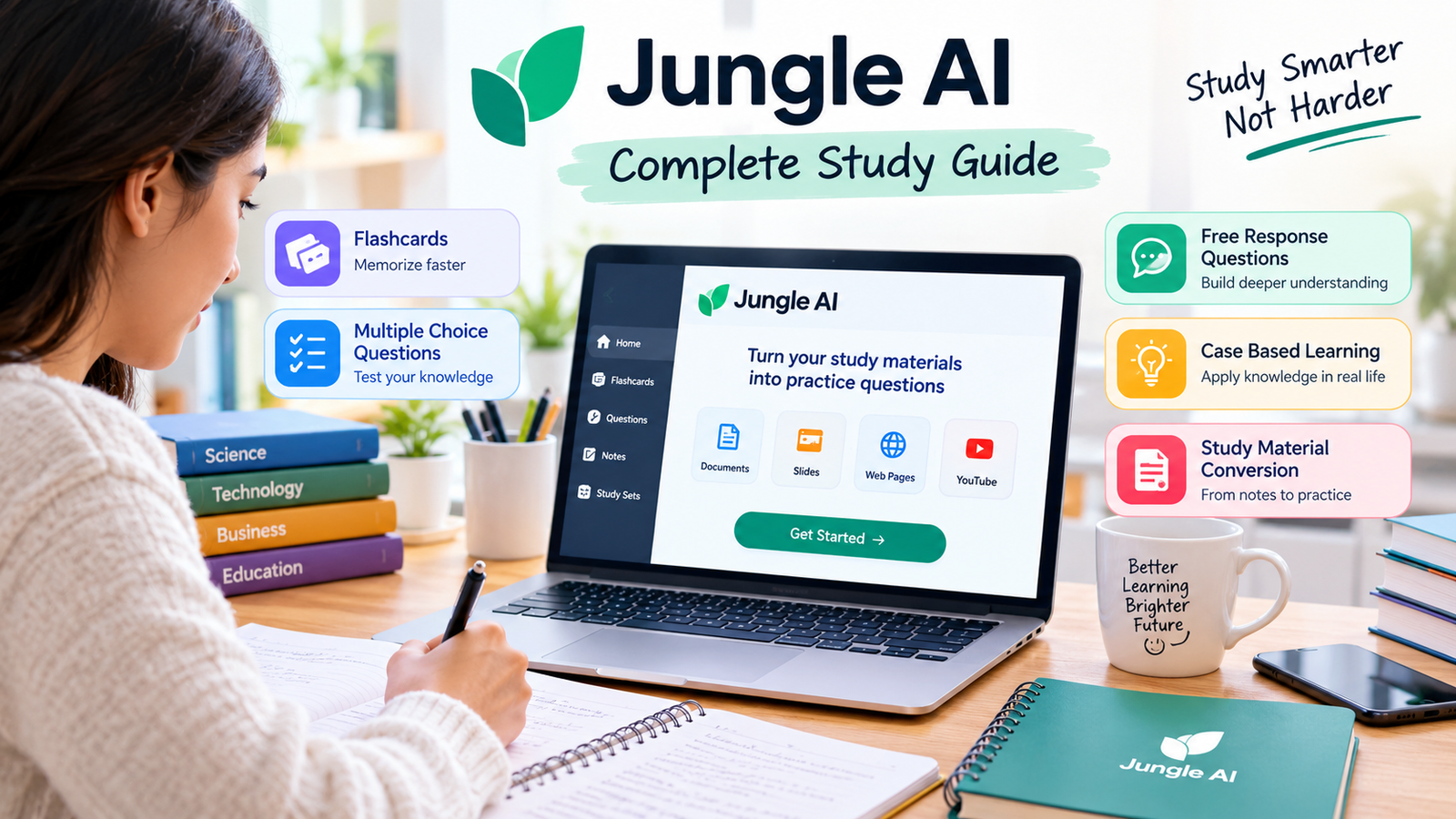
Jungle AI is an artificial intelligence powered study platform designed to help students learn more effectively, prepare for examinations, and organize their study materials. In modern education, students often spend hours reading textbooks, reviewing lecture slides, watching educational videos, and preparing notes. Although these activities are important, creating useful revision materials can take considerable time. Jungle AI addresses this challenge by transforming existing learning resources into interactive study tools, including flashcards, multiple choice questions, and practice exercises.
The main purpose of Jungle AI is to make studying more organized, engaging, and efficient. Instead of manually preparing every question, students can provide their learning materials and use artificial intelligence to generate practice content. This approach helps learners spend more time understanding important concepts and testing their knowledge. Jungle AI is particularly relevant for university students, school learners, and people preparing for professional examinations.
Another important aspect of Jungle AI is its focus on active learning. Reading information repeatedly does not always guarantee that a student understands or remembers it. Answering questions, recalling definitions, and reviewing mistakes can provide a more useful learning experience. By combining AI generated study materials with interactive practice, Jungle AI offers a practical option for students who want to improve their revision routines.
What Is Jungle AI?
Jungle AI is an educational technology platform that uses artificial intelligence to convert learning resources into study materials. Students can use supported documents, lecture slides, web pages, and YouTube videos to create questions and flashcards. Rather than starting from an empty page, learners can build their revision materials around information they are already studying.
The platform is designed to reduce the manual work associated with preparing for examinations. For example, a university student who has a long presentation about biology can use Jungle AI to generate questions from the presentation. These questions can then help the student review definitions, understand relationships between concepts, and identify topics that require additional attention.
Jungle AI also supports different ways of practising information. Flashcards are useful for remembering short facts, terminology, and definitions, while multiple choice questions allow students to test their understanding. Free response questions encourage learners to explain concepts in their own words, and case based questions can help them apply knowledge to particular situations.
However, Jungle AI should not be considered a complete replacement for teachers, textbooks, or independent thinking. Artificial intelligence can misunderstand information or generate questions that require correction. Students should therefore review generated materials carefully and compare important answers with reliable educational sources.
How Does Jungle AI Work?
Jungle AI follows a straightforward process that begins with existing study materials. A student first selects suitable content, such as lecture slides, a PDF document, or a supported educational video. The platform processes the available information and identifies concepts that may be useful for revision. It can then produce practice questions and other learning resources based on the submitted material.
After generating the study content, the student can begin answering questions and reviewing the information. This creates a more interactive experience than simply reading notes from beginning to end. When a learner encounters a difficult question, the next step is to revisit the relevant section, understand the explanation, and try again.
The usefulness of Jungle AI depends partly on the quality of the original material. Clear lecture slides containing accurate explanations generally provide a better foundation than incomplete notes or documents with confusing terminology. If the source material contains mistakes, the generated study resources may also contain inaccuracies.
Students should also select materials that match their examination syllabus. A generated question may be interesting but irrelevant to the topics covered in a particular course. Reviewing the output before beginning a study session helps ensure that the available questions support the learner’s actual academic goals.
Main Features of Jungle AI
AI Generated Flashcards
Flashcards are one of the most useful features associated with Jungle AI. A flashcard presents a question, term, or concept that the student must recall before checking the answer. Preparing a large collection of cards manually can be time consuming, especially when a course contains hundreds of definitions and technical terms.
Jungle AI helps simplify this process by generating flashcards from supported learning materials. A student studying chemistry, for example, may create cards covering chemical reactions, scientific definitions, and important formulas. A history student could create cards about historical events, important dates, and the relationships between different developments.
AI generated flashcards can make revision more flexible because learners can concentrate on individual concepts instead of repeatedly reading entire chapters. Nevertheless, students should check that each card accurately represents the source material. Complicated ideas may require additional explanation rather than a short question and answer format.
Multiple Choice Questions
Multiple choice questions allow students to assess their understanding by selecting an answer from several possible options. Jungle AI can generate this type of question from study materials, giving learners an opportunity to practise concepts before an examination.
These questions are particularly helpful when students need to review a large amount of information within a limited period. They can reveal whether a learner recognizes important definitions, understands basic principles, and can distinguish between similar concepts.
The quality of multiple choice questions matters. If incorrect options are too obvious, students may answer correctly without understanding the subject. If a question is unclear or contains inaccurate information, it may create unnecessary confusion. Reviewing difficult questions and checking their explanations can make the practice session more valuable.
Free Response Questions
Free response questions require students to produce their own answers instead of selecting from predefined options. This approach can help learners determine whether they genuinely understand a topic or merely recognize familiar words.
For example, a student studying computer science may be asked to explain how a database organizes information. Answering such a question requires recalling relevant concepts and expressing them clearly. Jungle AI can support this kind of practice by generating questions from the material supplied by the learner.
Free response practice is useful for subjects that require definitions, explanations, comparisons, or detailed reasoning. Students should compare their responses with trusted course materials because automated feedback may not always recognize every valid explanation.
Case Based Learning
Case based questions connect theoretical knowledge with practical situations. Rather than asking only for a definition, these questions encourage students to apply what they have learned to a realistic problem.
A business student might examine a scenario involving a company’s financial decisions, while a science student might interpret information from an experimental situation. This approach can encourage deeper thinking and help learners understand why particular concepts matter.
Jungle AI’s case question format can support students who need more than simple memorization. However, complex subjects still require independent reasoning, careful reading, and guidance from qualified teachers when necessary.
Study Material Conversion
Another useful feature of Jungle AI is its ability to work with different types of learning resources. Depending on supported formats and platform capabilities, students can use documents, presentation slides, web pages, and educational videos as starting points for their study sessions.
This flexibility can be helpful when information comes from several sources. A university student may have lecture presentations, digital textbooks, and recorded lessons covering the same subject. Turning these resources into practice questions can provide a more organized revision process.
Students should remember that converting material does not automatically guarantee complete coverage. Long documents may contain more information than a generated question set can represent. Reviewing the original source remains important, especially when preparing for examinations with detailed syllabuses.
Benefits of Using Jungle AI
One major benefit of Jungle AI is time efficiency. Students often spend substantial time converting lecture notes into questions and flashcards. Automating part of this preparation process can make it easier to begin practising without first creating every resource manually.
Another benefit is personalized revision. Different learners struggle with different concepts. A student may understand most of a chapter but repeatedly forget particular definitions or misunderstand a complex process. By using practice questions to identify these weaknesses, the student can focus additional attention on the areas that need improvement.
Jungle AI can also make studying more interactive. Instead of passively reading the same paragraph several times, learners can test their knowledge, consider possible answers, and examine their mistakes. This process encourages greater involvement in the learning experience.
The platform may also help students maintain a consistent study routine. Smaller practice sessions can be easier to manage than attempting to review an entire textbook in one sitting. When learners divide their work into manageable sections, they can track their progress and adjust their revision plans.
Another advantage is flexibility across subjects. The usefulness of Jungle AI is not limited to one academic discipline. Depending on the quality of the supplied materials, students may use it to review language terminology, business concepts, scientific definitions, historical information, and computer science principles.
Despite these advantages, results depend on how the tool is used. Generating questions is only the beginning of an effective study process. Students still need to understand explanations, verify important information, and practise applying their knowledge independently.
Jungle AI for School and University Students
School students can use Jungle AI to organize revision for classroom tests and final examinations. A learner studying geography, for instance, may create flashcards about geographical terms, natural processes, and important locations. Reviewing these cards regularly can make it easier to identify forgotten information.
University students may benefit from the platform when managing large lecture presentations and demanding course materials. Higher education often requires learners to understand complex concepts rather than simply memorize short definitions. Multiple choice, free response, and case based questions can provide different ways to practise these skills.
Students enrolled in medical, engineering, business, or science programs may also find question generation useful for reviewing terminology and theoretical principles. However, professional and technical subjects require particular care because small errors can significantly change the meaning of an explanation.
Jungle AI can complement classroom teaching, personal notes, textbooks, and discussions with instructors. It should not replace these resources. The strongest approach combines AI assisted revision with independent reading, practical exercises, and feedback from knowledgeable people.
Jungle AI for Examination Preparation
Examination preparation becomes difficult when students do not know which topics they understand well and which topics require more attention. Jungle AI can help address this problem by providing practice questions based on available course materials.
A useful strategy is to divide the syllabus into manageable sections. Students can create practice materials for each section and attempt the questions without looking at their notes. After completing a session, they can review incorrect answers and identify the concepts that caused difficulty.
The next step is targeted revision. Instead of repeating every topic equally, learners can spend additional time on weak areas. For example, a student preparing for a biology examination may understand cell structures but struggle with cellular respiration. Reviewing the relevant chapter and practising related questions can make revision more focused.
Jungle AI can also support repeated practice throughout the preparation period. Reviewing difficult concepts on different days gives students more opportunities to retrieve information from memory. This method is often more useful than leaving all revision until the night before an examination.
Nevertheless, AI generated questions should not be treated as guaranteed examination questions. Teachers may emphasize specific learning objectives, and actual examination formats can differ from automatically generated practice materials. Students should always consult their official syllabus and previous examination papers when available.
Understanding Active Recall and Spaced Repetition
Active recall is a learning method that involves retrieving information from memory instead of simply rereading it. Flashcards and practice questions provide opportunities to use this technique because learners must attempt an answer before checking whether it is correct.
Jungle AI supports this style of learning by transforming study materials into interactive questions. When a student answers a question without looking at the source, the activity encourages independent retrieval. Checking the answer afterward helps identify misunderstandings that might otherwise remain unnoticed.
Spaced repetition involves reviewing information at intervals rather than concentrating all practice into one session. For example, a student might review a difficult concept today, revisit it tomorrow, and practise it again several days later. The exact schedule can vary according to the learner’s needs and the difficulty of the material.
Combining active recall with spaced repetition can help students build a more structured revision routine. When these methods are available through a digital study platform, learners may find it easier to organize repeated practice.
However, no single technique guarantees academic success. Students also need adequate preparation time, clear learning objectives, sufficient rest, and opportunities to apply their knowledge to unfamiliar questions.
Read more about: magic hour ai
Is Jungle AI Easy to Use?
Jungle AI is designed to simplify the process of creating study materials. Its central workflow involves selecting suitable learning content, generating questions, and practising the resulting material. This structure can be easier to manage than manually creating a large collection of revision cards.
New users should begin with a short, clearly organized document. This makes it easier to evaluate the quality of the generated questions before processing larger collections of materials. Once students understand the available features, they can develop a routine that matches their academic requirements.
It is also important to review the generated content before relying on it. Students should correct unclear wording, remove irrelevant questions, and verify information that appears questionable. Taking these steps can prevent mistakes from becoming part of a revision routine.
The experience may vary according to the material being processed, available features, internet connectivity, and account limitations. Users should consult the platform’s current information for details about supported inputs, access options, and any applicable usage restrictions.
Jungle AI Pricing and Availability
Students considering Jungle AI should check the official platform for current pricing, available plans, and account requirements. Features and access limits can change, so it is better to confirm these details directly instead of relying on outdated descriptions elsewhere.
Some digital learning platforms provide limited access without payment and offer additional features through paid subscriptions. However, the precise availability of individual features, generation limits, and subscription terms should be checked before making a purchase.
Students working with a limited budget should evaluate whether the available features match their needs. Someone who only requires occasional flashcards may have different requirements from a university student who regularly processes extensive course materials.
Before purchasing a subscription, learners should consider the expected time savings, the usefulness of the generated questions, and any restrictions affecting their preferred workflow. A paid plan is worthwhile only when its benefits justify the cost for that particular student.
For accurate product information, supported study features, and access to the platform, visit the official Jungle AI website at Jungle AI.
Limitations of Jungle AI
Although Jungle AI can simplify study preparation, it has limitations that users should understand. Artificial intelligence systems may generate inaccurate answers, misunderstand complicated passages, or overlook important details in the source material. Students should not assume that every generated question is automatically correct.
The platform also depends on the quality of the information provided. Incomplete lecture notes may produce incomplete questions, while poorly organized documents can make important concepts harder to identify. Providing clear source material and reviewing the output can improve the overall experience.
Another limitation is that automated practice cannot fully replace classroom discussion, laboratory activities, practical experience, or expert feedback. Certain subjects require demonstrations, problem solving, communication skills, and hands on training that cannot be developed through flashcards alone.
Students should also protect their personal information when using online educational tools. Before uploading documents, they should check whether the materials contain confidential details, private student information, or content they are not permitted to share.
Finally, relying entirely on generated answers can create a false sense of confidence. Learners should continue reading original materials, explaining concepts independently, and solving unfamiliar problems to develop a deeper understanding of their subjects.
Tips for Getting Better Results with Jungle AI
Students can improve their experience by choosing clear, relevant source materials. Well organized lecture slides, readable documents, and accurate notes provide a stronger foundation for generating useful practice questions.
It is also helpful to set a specific objective before beginning a study session. Rather than generating questions from an entire course without a plan, learners can focus on one chapter, one lecture, or one difficult concept. This makes progress easier to evaluate.
After completing a practice session, students should review incorrect answers carefully. Simply seeing the correct option is not enough. Understanding why an answer is correct and why another answer is incorrect helps reveal gaps in knowledge.
Another useful strategy is to combine different question formats. Flashcards can help with quick recall, multiple choice questions can test recognition, and free response questions can encourage deeper explanations. Using different formats provides a broader view of the learner’s understanding.
Students should also compare generated materials with their original notes and official syllabus. This step helps identify missing topics and prevents irrelevant questions from taking too much study time.
Most importantly, learners should use Jungle AI as a support tool rather than a shortcut around learning. Consistent practice, independent reasoning, and careful review remain essential for long term academic progress.
Conclusion
Jungle AI is a useful AI powered study platform for students who want to transform learning materials into flashcards and practice questions. Its interactive approach can save preparation time, support active recall, and make examination revision more organized. However, students should verify generated information and continue using trusted educational resources. When combined with consistent practice and independent learning, Jungle AI can become a valuable part of an effective study routine.