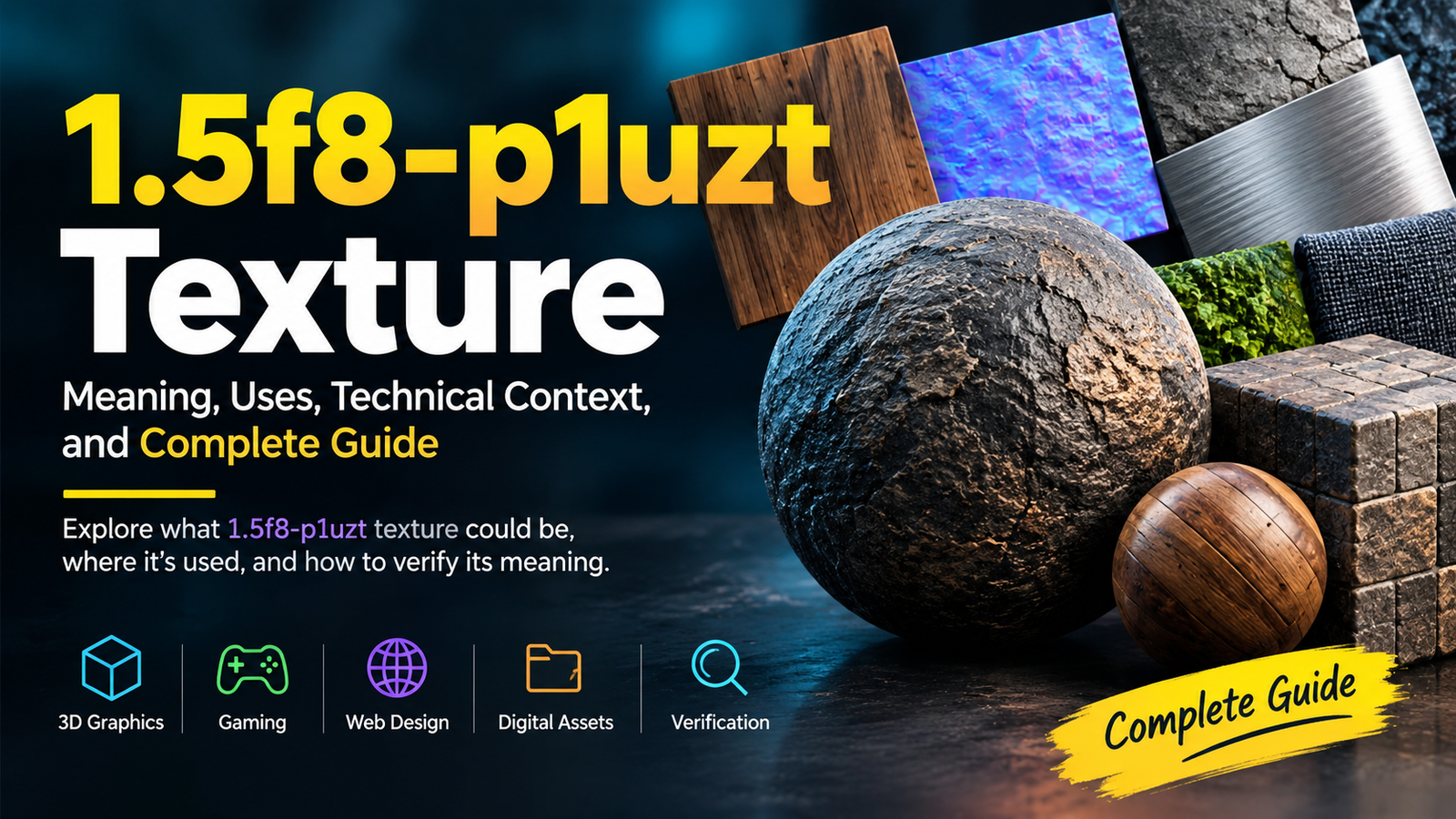
The term 1.5f8-p1uzt texture is an unusual keyword that combines numbers, letters, a hyphen, and the word texture. At first glance, it may look like a product identifier, material reference, digital asset name, texture code, internal catalog label, software-generated identifier, or technical naming convention. However, unusual keywords like this should not automatically be treated as a universally recognized technical term without reliable documentation.
Understanding 1.5f8-p1uzt texture requires looking at both parts of the phrase. The first part, “1.5f8-p1uzt,” has the appearance of an alphanumeric identifier, while “texture” provides a broader context connected with surface appearance, digital graphics, materials, design, visualization, and computer-generated imagery. Depending on where the phrase appears, it may describe a texture file, material preset, design asset, database reference, or another technical resource.
This complete guide explores what 1.5f8-p1uzt texture could represent, why such identifiers are used, how texture terminology works, where similar texture references appear, and how users can verify the actual meaning of an unfamiliar texture code.
What Is 1.5f8-p1uzt Texture
1.5f8-p1uzt texture does not appear to be a conventional texture term such as wood texture, stone texture, fabric texture, metal texture, or concrete texture. Instead, the unusual “1.5f8-p1uzt” portion looks more like an identifier attached to the word texture.
In digital environments, files and assets are frequently assigned names that contain numbers and letters. These names can be generated automatically by software, content management systems, asset libraries, databases, rendering platforms, or development environments. A texture asset might therefore have a name that looks unfamiliar to ordinary users while still serving a completely normal technical purpose.
The phrase 1.5f8-p1uzt texture could potentially refer to a specific digital texture asset. It could also represent an internal label that has meaning only inside the platform where it was created. Without an authoritative source explaining the identifier, it would be incorrect to claim that the code has one fixed definition.
This distinction is important for anyone researching 1.5f8-p1uzt texture online. Search results for unusual terms can sometimes contain incomplete information, automatically generated pages, unrelated references, or copied descriptions. A reliable interpretation should therefore be based on the original source, file metadata, documentation, or platform where the keyword was encountered.
Understanding the 1.5f8-p1uzt Part
The “1.5f8-p1uzt” section is particularly interesting because it follows a pattern commonly seen in machine-generated names. It contains digits, alphabetic characters, a decimal-like separator, and a hyphen.
This type of structure can appear in many technical environments. Software may generate identifiers to distinguish files, objects, resources, sessions, versions, database entries, or temporary assets. Designers and developers may also create short identifiers for assets stored inside large collections.
The presence of “1.5” does not necessarily mean that the phrase refers to version 1.5. Similarly, the characters “f8” should not automatically be interpreted as a hexadecimal value, and “p1uzt” should not automatically be assigned a specific technical meaning.
For 1.5f8-p1uzt texture, context is therefore more important than attempting to decode every character independently.
An identifier may be meaningful to the system that created it but meaningless outside that system. For example, a design application could use a generated identifier for a texture asset while a website could use a similar string for an uploaded image. Both could produce names that look technical even though their underlying purposes are completely different.
What Does Texture Mean in Digital Design
To understand 1.5f8-p1uzt texture, it helps to understand the word texture itself.
In visual design, texture describes the perceived surface characteristics of an object or material. A texture can make a surface appear rough, smooth, polished, grainy, metallic, wooden, fabric-like, rocky, or weathered. In traditional art, texture can be physical or visually represented. In digital graphics, texture is commonly represented using images, maps, procedural patterns, or material information.
Texture is especially important in three-dimensional graphics. A basic 3D model may define the shape of an object, while textures and materials provide visual information that makes the object look realistic or stylized.
For example, a digital model of a wooden table can have a simple geometric shape. A wood texture can add grain patterns and color variation. Additional material information can control how light interacts with the surface.
If 1.5f8-p1uzt texture is a digital asset, its actual appearance and purpose would depend on the file or software environment associated with the identifier.
1.5f8-p1uzt Texture in 3D Graphics
Textures are widely used in 3D modeling, game development, animation, architectural visualization, product visualization, and virtual environments.
A texture can be applied to a 3D model to create visual detail without requiring every small surface feature to be physically modeled. This can improve visual quality while keeping geometry manageable.
A texture asset may contain color information, surface details, patterns, transparency information, or other data used by a rendering engine. Modern workflows can also use multiple texture maps to control different properties of a material.
If 1.5f8-p1uzt texture represents such an asset, its role could depend on the software or project in which it is stored. The identifier itself does not reveal the exact texture category.
For example, a texture identifier might be associated with a material library, a game asset, an architectural scene, a product rendering project, or an experimental visual resource.
Texture Maps and Their Importance
Digital textures are not always limited to a single image. Modern rendering workflows often use different maps for different surface properties.
A color or albedo texture describes the visible base color of a material. A normal map can simulate small surface details by changing how light interacts with the surface. A roughness map controls how broadly or sharply reflected light appears. A metallic map can indicate which parts of a material behave like metal.
Other maps can control height, displacement, ambient occlusion, transparency, emission, or other visual characteristics.
If 1.5f8-p1uzt texture is connected to a 3D asset, the identifier might refer to one particular map rather than an entire material.
This is one reason why the source of an unfamiliar texture name matters. A filename alone may not provide enough information to determine whether the asset represents color, roughness, normal information, displacement, or another property.
Why Texture Files Use Unusual Names
Large digital projects can contain thousands of files. Human-readable names such as “wood-floor-final.png” can become difficult to manage when multiple versions and variations exist.
Automated systems solve this problem by generating unique identifiers. A generated identifier can reduce naming conflicts and help software connect assets with database records.
The unusual structure of 1.5f8-p1uzt texture could therefore be consistent with an automatically generated naming system.
Generated names can be useful because they can be unique, compact, and easy for software to process. They may also contain information about a project, object, version, or internal record.
However, users should avoid assuming that every character has a publicly documented meaning. In many systems, identifiers are simply generated values.
Learn more about:about software wuvdbugflox
1.5f8-p1uzt Texture and Digital Asset Libraries
Digital asset libraries are another possible environment where a term such as 1.5f8-p1uzt texture might appear.
Designers often maintain collections of textures for future projects. These collections can contain photographs, scanned materials, procedural textures, tileable patterns, surface maps, and complete material packages.
A library may assign internal identifiers to individual assets. The visible filename might therefore look unrelated to the visual appearance of the texture.
For organizations managing large asset collections, unique identifiers make it easier to search, update, replace, and track resources. A particular texture can be referenced by an identifier even when its descriptive title changes.
If you encounter 1.5f8-p1uzt texture inside an asset library, checking the surrounding folder, metadata, preview image, and file properties may reveal more information than searching for the identifier alone.
Possible File Formats for Texture Assets
Textures can exist in many file formats. Common image formats include PNG, JPEG, TIFF, and other formats depending on the workflow. Professional 3D pipelines can also use specialized formats designed for high-quality rendering and efficient storage.
The file extension is therefore an important clue when investigating 1.5f8-p1uzt texture.
A PNG file may contain transparency and is frequently used for graphics and texture maps. JPEG files are compressed and can be useful when file size matters. TIFF can preserve high-quality image information and is common in professional workflows. Other formats may be selected for particular rendering engines or production pipelines.
The identifier “1.5f8-p1uzt” by itself does not reveal the file format. The extension and metadata must be examined separately.
1.5f8-p1uzt Texture in Gaming
Video games rely heavily on textures to create detailed environments and objects.
A game world can contain buildings, roads, characters, weapons, vehicles, landscapes, clothing, furniture, and countless other objects. Textures help provide their visual appearance.
Game engines may organize these assets using internal names that are not intended for ordinary players. An identifier such as 1.5f8-p1uzt texture could theoretically be an internal asset reference if it was encountered within game files or development resources.
However, the keyword alone is not enough to associate it with a specific game or engine. Any claim connecting it to a particular title would require evidence from the original source.
1.5f8-p1uzt Texture in Web Design
Textures also have a long history in web design.
Websites may use background textures, repeating patterns, gradients, decorative images, and visual overlays to create a particular appearance. Modern websites often rely more heavily on CSS and optimized graphics, but image-based textures remain useful in certain designs.
A web developer might give uploaded assets automatically generated names. A content management system could also rename files during processing.
If 1.5f8-p1uzt texture was discovered in website code, an asset directory, or a browser-related resource, the surrounding HTML, CSS, image URL, and file extension could help identify its function.
How to Verify 1.5f8-p1uzt Texture
Verification is particularly important when researching an unfamiliar keyword.
The first step is to identify where the term was found. Was it displayed on a website, inside software, in a file name, in a game directory, in a design project, or in search results? The answer can completely change its interpretation.
The next step is to examine the exact spelling. A single character can distinguish one identifier from another. The punctuation, capitalization, decimal point, and hyphen should be preserved when searching for 1.5f8-p1uzt texture.
The surrounding information should also be examined. If the keyword appears next to a file extension, material name, product description, software label, or database field, that context can provide useful clues.
Metadata can also be valuable. Image properties may include dimensions, color information, creation software, timestamps, or other technical details. Not every file contains metadata, and metadata can sometimes be removed or modified, so it should be treated as supporting evidence rather than absolute proof.
Why You Should Not Assume a Meaning
Unusual keywords can be tempting to decode. People may see numbers and letters and immediately assume the phrase represents a version number, model number, chemical formula, product code, or technical standard.
That approach can lead to inaccurate conclusions.
For 1.5f8-p1uzt texture, there is currently no basis in the keyword itself to establish a single official definition. The safest approach is to treat it as an identifier or contextual phrase until reliable documentation proves otherwise.
This is especially important when publishing SEO content. Search engines value useful information, but misleading certainty can reduce the quality and credibility of an article. A strong article should distinguish between verified information and reasonable possibilities.
SEO Importance of 1.5f8-p1uzt Texture
From an SEO perspective, unusual keywords can be interesting because they may have lower competition than broad terms.
The phrase 1.5f8-p1uzt texture has a highly specific structure. A page targeting the exact phrase can potentially match searches where users are trying to identify the same term.
However, keyword repetition alone does not guarantee good rankings. Search engines increasingly focus on whether content satisfies the user’s intent.
A useful article should naturally explain the phrase, address possible interpretations, provide verification guidance, and avoid unsupported claims.
The keyword can appear in the title, introduction, relevant headings, body paragraphs, meta description, image context, and conclusion where appropriate. It should remain natural rather than being repeated mechanically.
How to Use the Keyword Naturally
Natural keyword placement is especially important with an unusual phrase.
Instead of repeating 1.5f8-p1uzt texture in every sentence, the article can use related expressions such as alphanumeric texture identifier, digital texture asset, texture reference, texture file, material resource, digital surface pattern, and texture asset name.
This creates semantic relevance while keeping the content readable.
Search engines can understand related terminology, so an article does not need to repeat the exact keyword excessively to communicate its topic.
For an unusual keyword, clarity is more valuable than aggressive repetition.
1.5f8-p1uzt Texture and Material Appearance
Texture and material are related but not identical concepts.
A texture can provide visual information, while a material defines how a surface interacts with light. In a 3D environment, a material may combine several texture maps with properties such as roughness, metallic behavior, transparency, and reflectivity.
This distinction matters if 1.5f8-p1uzt texture is associated with a 3D rendering workflow.
For example, a texture could contain a pattern representing wood grain, while the material determines whether that wood appears polished, rough, wet, or matte.
Therefore, identifying the texture does not always mean identifying the complete material.
Texture Quality and Resolution
If 1.5f8-p1uzt texture refers to a digital image asset, resolution may be an important characteristic.
High-resolution textures can preserve more visual detail when viewed close to a camera. Lower-resolution textures can be useful for smaller objects or situations where performance and file size are more important.
Texture quality is not determined only by resolution. Compression, image format, color accuracy, tiling behavior, filtering, and map type can also affect the final appearance.
In game development and real-time visualization, texture resolution must often be balanced against memory and performance requirements.
Seamless and Tileable Textures
A seamless texture is designed so that it can repeat without obvious edges.
Tileable textures are useful for large surfaces such as floors, walls, roads, fabrics, and natural materials. Instead of storing an enormous image covering an entire scene, a smaller texture can be repeated across a surface.
If 1.5f8-p1uzt texture represents a tileable asset, its usefulness could depend on whether the edges connect naturally and whether the repeating pattern is visually noticeable.
Seamless design is therefore an important consideration when evaluating digital texture resources.
1.5f8-p1uzt Texture for Creative Projects
Texture assets can support many creative projects.
Digital artists can use textures in illustrations, concept art, posters, 3D scenes, animations, architectural visualizations, and game environments. A texture can add depth and visual interest without requiring every detail to be manually painted.
If the 1.5f8-p1uzt texture keyword eventually proves to refer to a particular asset, its creative value would depend on the actual appearance, licensing terms, resolution, and intended use.
Before using an unfamiliar texture in a published project, users should verify its license. Some textures are free for commercial use, while others may require attribution or a paid license.
Licensing and Copyright Considerations
Finding a texture online does not automatically mean that it is free to use.
Digital texture assets can be protected by copyright. The license may specify whether the asset can be modified, redistributed, used commercially, or included in another product.
Therefore, anyone researching or using 1.5f8-p1uzt texture should identify the original source before incorporating it into a project.
If the texture is part of proprietary software, a paid asset library, or a commercial design package, additional restrictions may apply.
Checking the original license is safer than relying on descriptions from third-party websites.
Common Mistakes When Researching Unusual Texture Keywords
One common mistake is assuming that the identifier has a dictionary definition.
Another mistake is confusing an internal filename with a public product name. Software often creates technical names that are never intended to be searched by ordinary users.
A third mistake is trusting a single low-quality webpage without checking the original source.
Another problem is interpreting individual characters without evidence. The “1.5” in 1.5f8-p1uzt texture may look like a version number, but there is no guarantee that it actually represents a version.
Good research keeps these possibilities separate from verified facts.
Is 1.5f8-p1uzt Texture a Product
There is not enough information in the keyword itself to establish that 1.5f8-p1uzt texture is a commercial product.
The phrase could be a product code, internal asset name, database reference, file identifier, or generated string. It could also be a term associated with a particular digital design workflow.
A product claim should only be made when an authoritative source provides product information such as a manufacturer, official listing, documentation, or catalog entry.
Without that evidence, describing the phrase as a confirmed product would be speculation.
Is 1.5f8-p1uzt Texture a Software Feature
The same caution applies to software.
The phrase could potentially appear as an asset identifier inside software, but the keyword does not identify a specific application or feature by itself.
If the term was found inside a design program, checking the application’s asset browser, documentation, project files, or help resources would provide stronger evidence.
The exact environment is therefore essential for interpreting 1.5f8-p1uzt texture correctly.
Practical Research Approach
A practical research approach begins with the original source.
If the phrase was copied from a website, return to that page and inspect the surrounding text. If it came from a file, examine the filename, extension, folder structure, and metadata. If it appeared in software, check the application’s asset or material panel.
Search engines can then be used to compare references. Exact-match searching can help determine whether the same identifier appears elsewhere.
However, matching search results do not automatically prove that two references describe the same thing. The sources should be compared carefully.
This approach is more reliable than trying to reverse-engineer the identifier from its characters.
Future Possibilities for 1.5f8-p1uzt Texture
The meaning of an unusual keyword can become clearer when additional documentation appears.
If 1.5f8-p1uzt texture belongs to a software system, future documentation might explain its identifier structure. If it belongs to a digital asset library, additional listings could reveal its category and intended use.
The term could also disappear from public search results if it was only an internal identifier.
For this reason, research into unusual terms should remain flexible. New evidence can change the most reasonable interpretation.
Why Context Matters More Than the Code
The most important lesson about 1.5f8-p1uzt texture is that the code alone is not enough.
The word “texture” tells us that the phrase is connected in some way with surface appearance or a texture-related resource. The alphanumeric section may identify a particular asset or record. But the exact relationship cannot be established without knowing the source.
Context can come from a website, application, database, asset library, game engine, design project, or file system.
Once the original environment is identified, the identifier becomes much easier to interpret.
Final Thoughts on 1.5f8-p1uzt Texture
1.5f8-p1uzt texture is an unusual and highly specific keyword that appears to combine an alphanumeric identifier with the general concept of texture. The structure suggests that it could be associated with a digital asset, texture file, internal reference, material library, software resource, or another technical naming system.
At the same time, the keyword alone does not provide enough evidence to establish one official meaning. The characters should not automatically be interpreted as a version, product number, model, or technical specification.
For anyone searching for 1.5f8-p1uzt texture, the best approach is to investigate the original source, inspect the surrounding context, check file information when available, and distinguish verified facts from possibilities.
From an SEO perspective, this keyword offers an opportunity to create useful content because it is highly specific and potentially connected to a narrow search intent. The strongest content strategy is not simply repeating the phrase but explaining its possible context, discussing texture technology, showing how unfamiliar identifiers can be verified, and helping readers understand what evidence they should look for.
Ultimately, the real meaning of 1.5f8-p1uzt texture depends on where the term originated. Until an authoritative source provides a confirmed definition, it is best treated as a potentially technical or system-generated texture identifier rather than assigning it a meaning that cannot be verified.