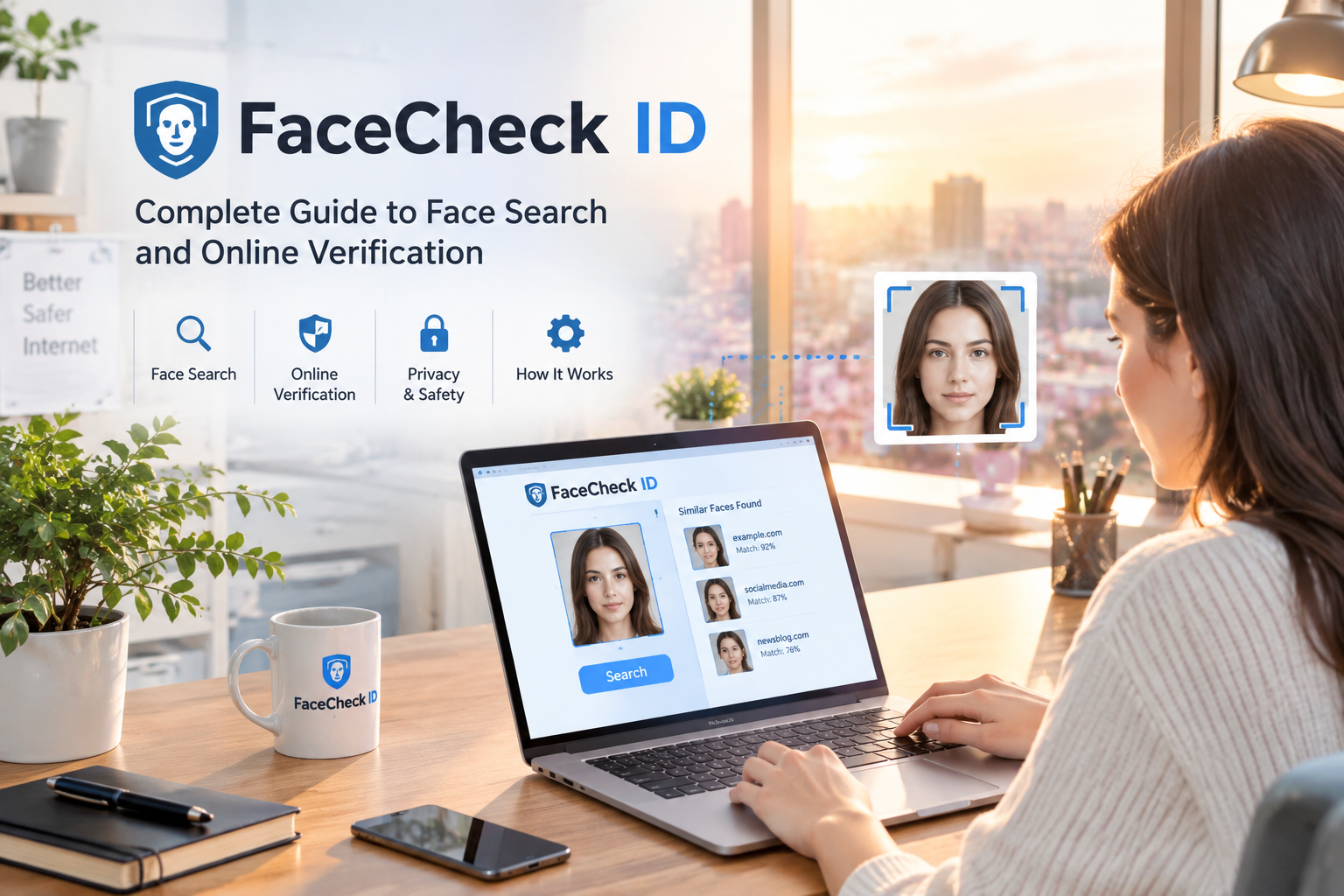
The internet is filled with millions of photographs, profile pictures, social media posts, news articles, blogs, and public webpages. With so much visual content available online, finding information about a particular photograph can sometimes be difficult. Traditional search engines usually depend on words, phrases, names, and other text-based information. FaceCheck ID takes a different approach by focusing on the face visible in an image and searching for similar appearances across publicly available webpages.
FaceCheck ID is a reverse face search engine designed to help users discover webpages where a particular face or a visually similar face appears. Instead of requiring a person’s name, username, or other identifying information, the service works from an uploaded photograph. According to its official information, the system detects faces, analyzes facial features, and compares them with faces found in its indexed web content. The results can then provide links to webpages containing potentially related images.
Although FaceCheck ID can be useful for image research, online safety, and checking where photographs appear on the web, it is important to understand what the technology can and cannot prove. A similarity score is not the same thing as confirmed identity. Different people can have similar facial features, and an image may have been copied or reused without the person’s knowledge. Therefore, FaceCheck ID should be viewed as a research tool rather than a guaranteed identity-verification system.
What Is FaceCheck ID?
FaceCheck ID is a face-focused reverse image search service. Its main purpose is to search the publicly accessible web for webpages containing faces that appear visually similar to the face in a submitted image.
A conventional reverse image search generally attempts to locate the same image or visually similar versions of an image. FaceCheck ID takes a face-centered approach. The system detects the face in a photograph and analyzes visual characteristics rather than depending entirely on the complete image. This can make the approach useful when the same person appears in different photographs, backgrounds, poses, or image formats.
For example, a photograph may originally show a person standing outdoors. Another website might publish a photograph of the same person indoors, wearing different clothing and using a different background. Because the surrounding image has changed, a traditional image search may not always connect the photographs. A face search system attempts to focus more directly on the facial characteristics.
The official FaceCheck ID FAQ explains that the service returns webpages where the face or similar-looking faces have appeared and emphasizes that its results should not be treated as guaranteed identity matches.
This distinction is important because online images can be misleading. A photograph can belong to one person while being uploaded by another person, reused in a fake profile, copied to another website, or presented with incorrect information.
How FaceCheck ID Works
Understanding how FaceCheck ID works makes it easier to understand both its advantages and limitations.
The process begins when an image containing a face is submitted. The system attempts to locate the face and analyze its visual characteristics. It then creates a mathematical representation of the facial features and compares that representation with faces available in its searchable index.
Modern face-search systems commonly use numerical representations called embeddings. These representations allow software to compare patterns and distances between facial features. FaceCheck ID describes its own process in similar terms, explaining that facial features can be converted into a numerical representation and compared with indexed faces.
The system then produces results according to similarity. A higher similarity score means that the system considers two faces more visually alike, but it does not automatically mean that the two photographs belong to the same individual.
This is one of the most important things to understand about FaceCheck ID. A face similarity system works with mathematical patterns, not human certainty. Lighting, camera angle, image quality, age, facial hair, filters, and other factors can influence the result.
FaceCheck ID and Reverse Image Search
FaceCheck ID is related to reverse image search, but the two approaches are not exactly the same.
Traditional reverse image search often looks for the same image, a modified copy, or visually related images. If a photograph is cropped, resized, edited, or heavily changed, finding an exact or near-exact copy can become more difficult.
FaceCheck ID focuses primarily on the face. This means that the surrounding environment may matter less than the facial characteristics.
Imagine a photograph being reused in several places. One version might have a large background, another might be cropped tightly around the face, and another might use a different background entirely. A face-focused search can potentially connect these appearances because the face remains the central visual feature.
However, neither approach is perfect. A search engine can only return information that exists within its available index. Private pages, deleted images, recently published content, restricted websites, and pages that have not been indexed may not appear.
FaceCheck ID Match Scores Explained
One feature associated with FaceCheck ID is its match quality scoring system. The official FAQ states that its scores range from 0 to 100 and represent how closely the facial appearance matches. It also divides scores into different categories of confidence.
A high score can be useful as an indication that two facial images are visually similar. However, users should not interpret the number as a probability that a particular person has been positively identified.
For example, a score of 90 does not mean there is a 90 percent certainty that the person has been legally or personally identified. The score is related to visual similarity between images.
This distinction is especially important when the search results could affect someone’s reputation or privacy. A person should not be accused of fraud, criminal activity, deception, or other wrongdoing simply because a face-search result appears to resemble them.
A responsible approach is to consider the score together with the surrounding webpage, image context, publication date, names, usernames, and other independent information.
What Makes a Face Search More Effective?
The quality of the submitted photograph can significantly influence the results.
A clear, front-facing photograph usually provides more useful facial information than a blurry photograph. Good lighting can also help because extreme shadows can hide important facial features.
Several factors can influence face-search results.
A frontal face generally provides more recognizable facial geometry than a strong side profile. Similarly, a high-resolution photograph can contain more useful information than a tiny image taken from a large group photograph.
Obstructions can also affect results. Sunglasses, masks, hands covering the face, extreme hair coverage, heavy filters, and significant image distortion may make facial analysis more difficult.
Age can also be a factor. A photograph taken many years ago may look considerably different from a recent photograph because of natural changes in appearance, hairstyle, facial hair, and other visual characteristics.
The FaceCheck ID documentation similarly notes that clear, unobstructed, well-lit faces tend to produce stronger results.
Why FaceCheck ID May Return No Results
A search without results does not necessarily mean that the person has no online presence.
FaceCheck ID depends on webpages and images that have been discovered and indexed. If an image is private, newly uploaded, deleted, inaccessible, or simply outside the search engine’s index, it may not appear.
The quality of the uploaded image can also influence the result. If the face is extremely small, blurry, partially hidden, or photographed from an unusual angle, the system may have difficulty finding meaningful matches.
Another possibility is that the person simply has very little publicly indexed photographic content.
Therefore, a “no results” search should be interpreted carefully. It means that the system did not find a suitable match in the available searchable material. It does not prove that a person does not exist online.
Common Uses of FaceCheck ID
FaceCheck ID can have several legitimate applications when used responsibly.
One common use is checking whether a photograph has appeared elsewhere online. This can be useful when someone encounters an unfamiliar profile photograph and wants to understand whether the image is reused on other public webpages.
Another potential use is personal image monitoring. Someone may want to discover whether their own publicly available photograph has appeared on websites they were unaware of.
Researchers and journalists may also use reverse face-search technology as one part of broader open-source research. Bellingcat’s toolkit documentation describes FaceCheck ID as a possible step in open-source investigation while emphasizing that facial search should not be treated as a reliable standalone identification method.
FaceCheck ID can also be relevant when researching the origin or distribution of an image. If a photograph appears in multiple places, comparing the associated webpages and publication dates may help users understand how the image has traveled across the internet.
The important point is that these applications should remain within appropriate privacy, legal, and ethical boundaries.
Rad more about: opinion edge
FaceCheck ID for Online Safety
Online safety is another area where reverse face-search technology can be useful.
People sometimes encounter profiles using photographs that may have been copied from elsewhere. A face-search result can potentially reveal that the same photograph or face appears on multiple unrelated webpages.
However, finding the same photograph elsewhere does not automatically prove that a profile is fraudulent. There are many legitimate reasons for the same photograph to appear on multiple websites. A professional may use the same headshot on a company website, conference page, social profile, and personal website.
Context therefore matters.
A responsible review should consider the entire webpage rather than focusing only on a facial match. Users should examine whether the names, dates, descriptions, and other publicly available information are consistent.
FaceCheck ID itself emphasizes that facial matching cannot provide a guaranteed identity determination.
Privacy and FaceCheck ID
Privacy is one of the most important subjects surrounding face-search technology.
Face images can be sensitive because a face is directly connected to a person’s physical appearance. Users should therefore think carefully before uploading photographs to any online service.
According to FaceCheck ID’s published FAQ, searched images are not added to its searchable database, and it states that search history and related information are deleted after a limited period. It also says that it does not store the original source images in its database and instead uses low-resolution thumbnails and webpage links for indexed content.
The company also states that its system is designed to search publicly available webpages rather than private accounts or restricted content.
For the most current information about the service, users should review the official FaceCheck ID website and its current privacy and terms information before uploading any photograph.
Privacy policies and technical practices can change, so relying on an old description of a service is not recommended.
Does FaceCheck ID Identify People?
The answer requires an important distinction.
FaceCheck ID can find webpages containing faces that are visually similar to the submitted face. However, a similarity result is not the same as a verified identity.
According to the service’s own FAQ, FaceCheck ID does not provide a guaranteed positive identity match. It explains that even sophisticated artificial intelligence systems can produce incorrect matches because unrelated people may have similar facial characteristics.
This means that users should not treat a result as conclusive evidence about someone’s identity.
A responsible research process should combine visual similarity with independent information. If multiple public webpages contain the same face and consistent contextual information, the overall evidence may become more meaningful. Even then, users should avoid making serious accusations based solely on automated facial similarity.
FaceCheck ID and False Positives
False positives are an important limitation of face-search technology.
A false positive happens when a system identifies two faces as sufficiently similar even though they belong to different people.
This can happen because people naturally share facial characteristics. Lighting, camera quality, facial expressions, age, hairstyle, makeup, and image processing can also influence how a face appears.
Identical or closely related people can create particularly challenging cases. Even unrelated individuals may look remarkably similar.
For this reason, a FaceCheck ID result should be treated as a lead rather than a final conclusion.
If a result appears surprising, users should check the original webpage and look for additional evidence. The webpage’s publication date, surrounding text, profile information, and other photographs can provide important context.
FaceCheck ID and Social Media
Social media contains enormous amounts of photographic content, but not all of it is publicly searchable.
A person may have private accounts, restricted posts, deleted content, or photographs that search engines have never indexed. As a result, FaceCheck ID cannot be expected to find every social media appearance of a face.
A successful match also does not necessarily reveal ownership of an account. Photographs can be copied, reposted, or used without permission.
This is especially important when analyzing profile pictures. Seeing a photograph on a particular page does not automatically establish that the person pictured created or controls that page.
The safest approach is to treat social media results as contextual information rather than definitive proof.
FaceCheck ID for Personal Image Monitoring
People who publish photographs online may sometimes wonder where their images appear.
A reverse face search can help individuals understand the public footprint of their photographs. For example, an individual might discover that an old professional photograph appears on a website they no longer use.
Personal image monitoring can also help users become more aware of how widely their public photographs have circulated.
If someone discovers unauthorized use of their photograph, they can review the relevant website’s policies and applicable legal options. Depending on the situation, a user may be able to contact the website owner, hosting provider, or platform where the image appears.
The appropriate response depends on the circumstances and local law.
Ethical Considerations When Using FaceCheck ID
Face-search technology raises important ethical questions because a photograph can be transformed into a searchable facial reference.
A person may have intentionally made a photograph public without expecting it to become searchable through facial similarity. This creates a difference between ordinary image publication and face-based discoverability.
For this reason, users should think carefully about why they are performing a search and how they intend to use the information.
FaceCheck ID’s own material discusses concerns involving consent, accuracy, false positives, and responsible use of search results.
Users should avoid using facial search to harass, threaten, embarrass, or expose private information about another person.
They should also avoid publishing unverified accusations based on automated search results.
Responsible use means treating the technology as an information-retrieval tool while respecting privacy and human judgment.
FaceCheck ID and Children
Face-search technology requires additional caution when minors are involved.
FaceCheck ID states that its system is trained for adult faces and that searching for images of children is prohibited under its terms.
This highlights an important principle for online safety: facial images of minors should receive stronger privacy protections.
Users should not attempt to use face-search systems to investigate or expose children. If a photograph involving a minor appears online in a concerning context, the safer approach is to use appropriate reporting mechanisms or seek help from a trusted adult or relevant authority.
Advantages of FaceCheck ID
One advantage of FaceCheck ID is that it focuses on faces rather than relying entirely on the original image.
This can potentially help discover different photographs of the same face when the surrounding image has changed.
Another advantage is that it can provide webpage links rather than simply returning an image comparison. These pages can give additional context about where a photograph or similar face has appeared.
The system can also be useful for personal image awareness, open-source research, and checking the possible reuse of public photographs.
Its main value comes from helping users discover information that may not be easy to find through ordinary text searches.
Limitations of FaceCheck ID
Despite its capabilities, FaceCheck ID has significant limitations.
The first limitation is index coverage. A search engine cannot find content that it has not crawled or indexed.
The second limitation is accuracy. Facial similarity is not the same as identity confirmation.
The third limitation is image quality. Poor lighting, low resolution, unusual angles, filters, and facial obstructions can reduce the quality of results.
Another limitation is context. A face may appear on a webpage for many reasons, and the webpage may contain inaccurate or outdated information.
Finally, results can change over time. Websites publish new images, remove old pages, update photographs, and change their accessibility. Search engines also update their indexes and algorithms.
Therefore, FaceCheck ID should be considered a useful research aid rather than a perfect source of truth.
FaceCheck ID vs Traditional Search Engines
Traditional search engines are primarily text-based. Users usually enter keywords, names, topics, or phrases to find webpages.
FaceCheck ID reverses the process by starting with a face photograph.
This difference can be useful when a user does not know the person’s name or other textual information. Instead of asking a search engine a question using words, the user provides an image and allows the system to search for related visual appearances.
However, traditional search engines remain important because they can provide contextual information that facial search alone cannot establish.
A strong research process can therefore involve multiple types of evidence rather than relying on one technology.
Tips for Interpreting FaceCheck ID Results
The best way to interpret FaceCheck ID results is cautiously.
Start by examining the quality of the match. A clear, high-quality photograph deserves more attention than a blurry or heavily edited image.
Next, inspect the original webpage. Do not rely only on a thumbnail or automated score.
Look at the date, surrounding text, image captions, and other photographs.
If several independent webpages show the same face with consistent information, that provides more context than one isolated result.
At the same time, avoid assuming that consistency automatically proves identity. Images can be copied across websites, and incorrect information can spread widely.
Most importantly, do not use an automated face match as the sole basis for serious claims about another person.
Is FaceCheck ID Accurate?
FaceCheck ID can be useful, but its accuracy depends on many factors.
A high-quality, front-facing photograph generally provides better information than a blurry or obstructed image. The quality of the indexed photograph also matters.
FaceCheck ID explains that its match score reflects similarity rather than guaranteed identity.
Therefore, the most accurate answer is that FaceCheck ID can produce useful visual matches, but no individual result should automatically be treated as confirmed identity.
The quality of the evidence should always be evaluated in context.
Is FaceCheck ID Safe to Use?
Safety depends partly on how the service is used and what information a person chooses to upload.
Users should avoid uploading photographs containing sensitive information unless they understand the relevant privacy implications.
They should also review the current privacy policy and terms before using the service.
Most importantly, users should think about the consequences of the information they discover. Finding a photograph online does not automatically mean that the person pictured has done anything wrong.
Responsible use requires privacy awareness, careful interpretation, and respect for other people’s rights.
Final Thoughts on FaceCheck ID
FaceCheck ID represents an interesting development in reverse image and face-search technology. By focusing on facial characteristics rather than only the original image, it can help users discover webpages where similar faces appear across the public web.
The technology can have legitimate uses in personal image monitoring, online research, image investigation, and digital safety. However, its results should always be interpreted carefully.
A facial similarity score is not a guaranteed identity. Search coverage is not complete, and false positives can occur. Public photographs can also be copied, misused, or associated with incorrect names and information.
The most responsible approach is to use FaceCheck ID as a starting point for research rather than as final proof. Users should examine the original webpages, compare independent contextual information, respect privacy, and avoid making serious claims based solely on an automated facial match.
As reverse face-search technology continues to develop, understanding both its capabilities and limitations will become increasingly important. FaceCheck ID can make visual research easier, but good judgment remains essential. Technology can identify patterns and surface possible matches; people still need to evaluate the meaning and reliability of those results carefully.