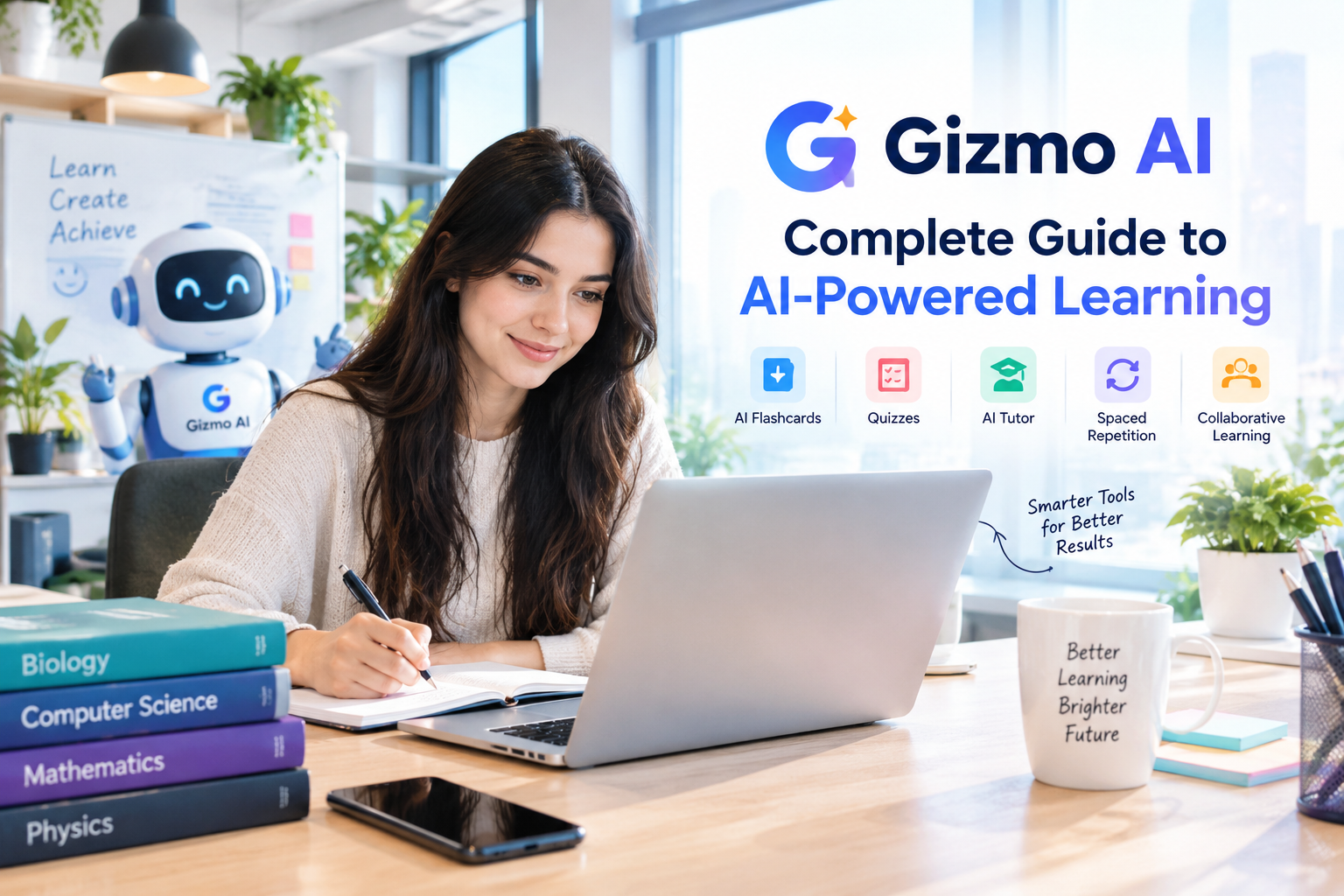
Gizmo AI is a modern learning platform designed to make studying more interactive, organized, and efficient. Instead of spending hours creating flashcards manually, students can use AI-powered tools to transform notes, PDFs, presentations, videos, and other study materials into useful learning resources. The platform combines artificial intelligence with techniques such as active recall and spaced repetition to create a more engaging study experience.
As digital learning continues to grow, students are increasingly looking for tools that can simplify revision without making the learning process complicated. Gizmo AI addresses this need by bringing flashcards, quizzes, AI tutoring, practice tests, and collaborative learning features together in one platform. Its system is designed around the idea that students can learn more effectively when they regularly test their knowledge instead of simply reading the same material repeatedly.
What Is Gizmo AI?
Gizmo AI is an AI-powered educational platform that helps users create and review learning materials. The platform can turn existing study content into flashcards and quizzes, allowing learners to spend less time preparing revision materials and more time actually studying.
One of the main features of Gizmo AI is its ability to process different types of content. According to the platform’s current help documentation, users can import PDFs, notes, PowerPoint presentations, photos, recordings, YouTube content, Quizlet sets, Anki decks, spreadsheets, and website content through its Magic Import system.
This makes Gizmo AI useful for students who already have large amounts of study material but do not want to manually convert every chapter or lecture into flashcards. Once content is imported, the system can identify important information and generate cards that can be reviewed through its learning modes.
The platform also includes an AI Tutor that can explain subjects, create notes, generate flashcards, provide lessons, and create AI-generated quizzes.
How Gizmo AI Works
The basic idea behind Gizmo AI is straightforward. A learner starts with information they want to understand or memorize. That information can come from notes, a PDF, presentation, recording, webpage, or another supported source.
The content can then be imported into Gizmo AI. The platform processes the material and generates learning resources such as flashcards. Users can review these cards, answer questions, and identify areas where they need additional revision.
Gizmo AI also uses spaced repetition in its Memorise mode. When a learner answers a card correctly, the system can wait longer before showing that information again. When a learner struggles with a card, it can return sooner for additional practice.
This approach helps organize revision around the information that requires more attention rather than treating every flashcard exactly the same.
AI Flashcards in Gizmo AI
Ai Flashcards are one of the central features of Gizmo AI. Traditional flashcard creation can take considerable time because students have to read their material, identify important concepts, write questions, and create answers.
Gizmo AI attempts to reduce that preparation work by using artificial intelligence to generate flashcards from existing content. The platform supports several card formats, including standard text cards, multiple-choice questions, matching cards, ordering questions, and true-or-false cards.
This variety makes revision more interactive. For example, a student studying history could use standard question-and-answer cards for important dates and concepts, while a science student could use multiple-choice questions to test terminology.
Flashcards can also help learners divide a large subject into smaller pieces. Instead of trying to remember an entire chapter at once, students can review individual concepts and gradually build a stronger understanding of the subject.
Magic Import Feature
Magic Import is another important part of Gizmo AI. It is designed to convert existing study material into flashcards without requiring users to manually type every card.
The system supports multiple sources, including PDFs, PowerPoint presentations, notes, photos, recordings, Quizlet sets, Anki decks, spreadsheets, and websites.
For example, a student could have a PDF containing lecture notes. Rather than copying each important definition into a separate flashcard, the student can import the document and allow Gizmo AI to create cards from the content.
The same concept can be applied to presentation slides. Students who receive PowerPoint material for a course can use the information as the foundation for AI-generated revision resources.
However, automatically generated material should still be reviewed. AI can misunderstand context or miss information, so checking generated cards against the original study material is a useful part of the learning process.
Read more about: facecheck id
Gizmo AI AI Tutor
The AI Tutor gives Gizmo AI a more interactive learning experience than a traditional flashcard application.
Students can use the AI Tutor when they need help understanding a particular subject. According to Gizmo’s current documentation, the tutor can start courses, generate flashcards, create notes, provide step-by-step lessons, and produce AI-generated quizzes.
This means learners can move between different learning methods depending on their needs.
If a student does not understand a concept, they can use an explanatory lesson. If they understand the concept but need to memorize important details, flashcards may be more appropriate. If they want to check their progress, an AI-generated quiz can provide another way to test their knowledge.
The AI Tutor can also work with existing decks, allowing learning sessions to build around material that has already been created.
Spaced Repetition and Active Recall
Two important learning techniques associated with Gizmo AI are spaced repetition and active recall.
Active recall means trying to retrieve information from memory instead of simply reading it again. Flashcards and quizzes naturally encourage this process because the learner has to answer a question before seeing or confirming the answer.
Spaced repetition adds timing to the process. Instead of reviewing every piece of information at the same interval, a spaced-repetition system can bring difficult information back more frequently and delay cards that have already been mastered.
Gizmo AI explains that its Memorise mode tracks answers and uses those results to determine when individual cards should appear again.
This can make revision more targeted because students can spend more time on information they have not mastered yet.
Gizmo AI Practice Tests
Practice tests provide another way to use Gizmo AI for exam preparation. The platform can generate AI-based tests from a course, deck, or selected topic.
Users can select the number of questions and provide additional instructions about the desired topic or difficulty. This makes practice testing more flexible than simply reviewing the same flashcards repeatedly.
Practice tests can also reveal knowledge gaps. A learner may feel comfortable reading a chapter but discover through testing that certain concepts are difficult to recall without assistance.
Using practice tests alongside flashcards can therefore create a more varied revision routine.
Learning From PDFs and Notes
Many students already have digital notes, textbooks, lecture documents, and study guides. Gizmo AI can turn these existing resources into interactive learning materials.
For example, a learner can import a PDF and allow the platform to identify important content for flashcards. Notes can also be pasted into the system and converted into study resources.
This approach can be particularly useful when preparing for subjects that contain large amounts of terminology, definitions, processes, or factual information.
Instead of creating a completely separate study system, students can use their existing material as the starting point.
Learning From YouTube Content
Video-based learning has become common among students, and Gizmo AI also supports learning workflows involving YouTube content.
According to the platform’s documentation, users can provide a YouTube link through Magic Import, allowing Gizmo AI to work from the video’s transcript and create learning material.
This can be useful when educational information is presented primarily through video. Rather than watching the same video repeatedly, learners can use generated questions and flashcards to actively test what they understood.
As with other AI-generated content, students should verify important information against reliable educational sources when accuracy is especially important.
Different Flashcard Types
Gizmo AI provides several types of flashcards, which can make studying less repetitive.
Text cards are useful for straightforward question-and-answer revision. Multiple-choice cards allow students to choose an answer from several options. Matching cards can be useful for connecting related concepts, while ordering cards can test sequences and processes. True-or-false cards offer another quick way to check understanding.
Different subjects may benefit from different card types. A language learner might use matching cards for vocabulary, while a biology student could use question-and-answer cards for terminology and processes.
Using different formats can also make study sessions more varied.
Gizmo AI for Exam Preparation
Exam preparation often involves reviewing a large amount of information within a limited period. Gizmo AI can help organize that process by turning study material into smaller, testable sections.
A student can create decks for different subjects or topics and then use Memorise mode to review them. Practice tests can be used to evaluate understanding, while the AI Tutor can provide additional explanations when a topic remains unclear.
A practical study routine could involve learning new material first, reviewing flashcards regularly, and then using practice tests to measure progress.
The goal should not simply be to complete as many cards as possible. The more useful approach is to focus on understanding concepts and identifying information that needs additional review.
Gizmo AI for Different Subjects
Gizmo AI can be applied to many different academic subjects because its basic learning tools are not limited to one discipline.
Students studying biology can create flashcards for terminology, processes, and scientific concepts. History students can use cards for events, dates, people, and causes. Language learners can practice vocabulary and definitions. Students in technology-related subjects can create cards for technical terms, concepts, and processes.
The usefulness of Gizmo AI depends partly on the quality of the material provided. Clear and accurate source material gives the system a stronger foundation for generating useful study resources.
Gizmo AI for Personalized Learning
One of the advantages of AI-based learning platforms is the ability to make study sessions more adaptable.
Instead of giving every learner the same fixed sequence, Gizmo AI can support different workflows. One student may prefer flashcards, another may rely more heavily on practice tests, while someone else may use the AI Tutor to understand difficult topics before moving into memorization.
The platform’s learning system also responds to quiz performance in Memorise mode, helping determine when cards should return for review.
This can make studying feel more personalized without requiring students to manually plan every review interval.
Gizmo AI and Collaborative Learning
Learning does not always have to happen individually. Gizmo AI includes a feature called Gizmo Live, which can turn decks into real-time multiplayer quizzes.
According to the platform’s documentation, students can share a game code and compete with friends or classmates while answering questions.
Collaborative quizzes can make revision more social and provide another way to test knowledge. They may be particularly useful for study groups that want to review the same material together.
Benefits of Using Gizmo AI
Gizmo AI offers several features that can simplify the study process. Its ability to transform existing material into flashcards reduces the amount of manual preparation required.
Its combination of active recall, spaced repetition, quizzes, and AI tutoring also gives students multiple ways to interact with the same subject.
Another benefit is flexibility. Students can work with different types of source material rather than being limited to manually created cards.
The platform can also support short revision sessions. Instead of waiting until the day before an exam, students can review small groups of cards regularly and use practice tests to monitor their understanding.
Limitations to Consider
Although Gizmo AI can make studying more convenient, it should not completely replace careful learning.
AI-generated flashcards may occasionally contain incomplete information, misunderstand a sentence, or focus on a less important detail. Reviewing generated cards is therefore important, particularly for technical or high-stakes academic subjects.
Students should also avoid assuming that simply completing flashcards guarantees mastery. Understanding the underlying concepts remains important.
Another consideration is that automated tools work best when users provide clear source material. Poorly organized or inaccurate notes can lead to less useful generated content.
How to Use Gizmo AI Effectively
To get more value from Gizmo AI, students can start with organized and reliable study material. Instead of importing an extremely large document at once, dividing content into logical sections can make the resulting cards easier to review.
The platform itself recommends using smaller sections for large documents because this can help keep the generated material focused and reduce the chance of information being skipped.
Students can then combine different learning methods. Flashcards can be used for regular recall, the AI Tutor can help explain difficult concepts, and practice tests can be used to check overall understanding.
Regular study sessions are generally more manageable than attempting to review everything immediately before an exam.
Is Gizmo AI Free?
Gizmo AI offers free access, although some free-plan usage limits apply. Its current help documentation states that users can start learning through the app without paying, while certain activities may involve waiting periods. For example, the documentation describes a wait between Magic Import uses on the free plan and a waiting period after losing available quiz lives.
The exact availability of features and subscription options can change, so users should check the current Gizmo AI website for the latest account and pricing information.
Gizmo AI on Mobile Devices
Gizmo AI is available through both iOS and Android applications. The platform states that users can begin learning for free through its mobile apps.
Mobile access can make revision easier to fit into short periods during the day. A learner can review cards while taking a study break or complete a short quiz session without needing a desktop computer.
However, the most important factor is not the device itself but how consistently the learner uses the study system.
Gizmo AI vs Traditional Flashcards
Traditional flashcards remain useful because they encourage active recall, but creating them manually can take time.
Gizmo AI changes the preparation process by allowing artificial intelligence to generate cards from existing content. This can reduce repetitive work and allow students to focus more heavily on reviewing and understanding.
Manual flashcards still have an advantage when students want complete control over wording, examples, and organization. AI-generated cards can be faster, but they should be reviewed before being treated as authoritative.
A balanced approach can therefore involve using Gizmo AI for initial generation and then editing or checking cards as needed.
Why Gizmo AI Is Becoming Relevant in Digital Education
AI is changing how students interact with educational content. Instead of simply searching for information, learners can increasingly use AI tools to transform information into questions, summaries, explanations, and personalized practice.
Gizmo AI fits into this broader development by combining AI-generated learning material with established study techniques.
Its focus on flashcards, active recall, spaced repetition, tutoring, and testing gives learners several ways to interact with information. The platform is therefore not simply an AI chatbot; it is structured around a study workflow.
Final Thoughts on Gizmo AI
Gizmo AI provides a collection of AI-powered tools designed to make studying more interactive and organized. Its ability to convert PDFs, notes, presentations, videos, and other content into flashcards can reduce the amount of manual preparation required from students.
The platform also combines flashcards with AI tutoring, practice tests, spaced repetition, active recall, and collaborative quizzes.
For students who already have substantial study material, Gizmo AI can provide a convenient way to turn that material into interactive revision resources. However, AI-generated content should still be reviewed for accuracy, and learners should focus on genuine understanding rather than simply completing a large number of questions.
Ultimately, Gizmo AI works best as a study assistant rather than a replacement for learning. When combined with reliable source material, regular revision, active recall, and thoughtful review, it can become a useful part of a modern digital study routine.