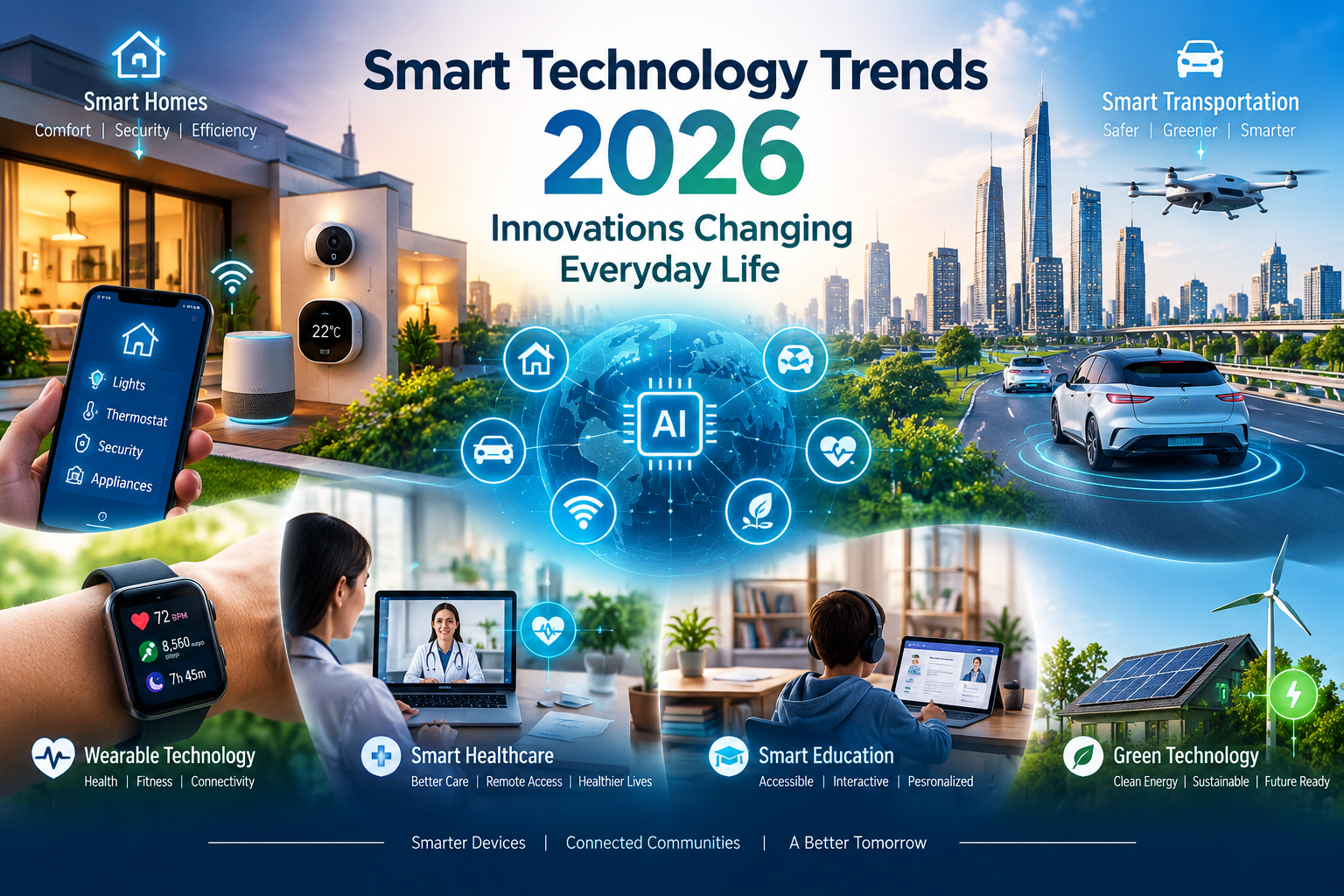
Smart technology is changing the way people live, work, communicate, and manage their daily activities. From artificial intelligence and smart home devices to wearable gadgets and connected vehicles, modern innovations are making everyday life more convenient and efficient. In 2026, smart technology trends are becoming increasingly important as businesses and individuals adopt digital solutions to save time, improve productivity, and solve common problems. These developments are not limited to large companies or technology experts. Ordinary people can also benefit from intelligent devices and digital services in their homes, schools, workplaces, and communities.
Smart technology trends in 2026 focus on automation, artificial intelligence, connected devices, digital security, and personalized experiences. These innovations help devices understand user needs, exchange information, and perform tasks with less manual effort. However, technological progress also introduces challenges related to privacy, affordability, and responsible use. Understanding these developments can help people make better decisions when choosing digital tools and preparing for a more connected future.
What Is Smart Technology?
Smart technology refers to devices, systems, and applications that use digital processing, sensors, connectivity, or artificial intelligence to perform tasks more intelligently. Unlike traditional devices, smart systems can often collect information, respond to changing conditions, and automate certain activities. Examples include smart thermostats that adjust temperatures, watches that monitor physical activity, and voice assistants that answer questions or control connected appliances.
The main purpose of smart technology is to make everyday tasks easier, faster, and more efficient. These solutions can help people manage household energy use, organize their schedules, communicate with others, and access information. Businesses also use intelligent systems to manage inventory, improve customer service, and analyze information.
In 2026, smart technology trends are moving toward better integration between devices and services. Instead of operating separately, different systems can increasingly work together. For example, a smartphone may control home lighting, receive security alerts, and display information from wearable devices. This connected experience can save time, although it requires reliable networks and suitable security protections.
Artificial Intelligence Is Transforming Everyday Activities
Artificial intelligence is one of the most influential developments in modern technology. AI systems can analyze information, recognize patterns, generate content, and assist with tasks that previously required significant human effort. In 2026, artificial intelligence is becoming more accessible through search tools, productivity applications, customer support services, and creative platforms.
People can use AI assistants to organize daily schedules, summarize documents, brainstorm ideas, and understand complicated information. Students may use these tools to explore educational topics, while professionals can apply them to research, planning, and routine administrative work. AI-powered applications can also help businesses respond to customers more quickly.
Another important development is the growth of AI agents that can complete sequences of tasks with limited supervision. Depending on their capabilities and permissions, these systems may help organize information, prepare reports, or coordinate certain digital workflows. However, users should review important results because AI can produce incorrect information or misunderstand instructions.
The future of smart technology depends partly on how effectively artificial intelligence combines with existing devices. When used responsibly, AI can reduce repetitive work and make digital services more personalized. Nevertheless, human judgment remains important, particularly when decisions affect finances, employment, safety, or personal information.
Read more about: Technology
Smart Homes Are Becoming More Connected
Smart home technology allows people to control household devices through smartphones, voice commands, sensors, or automated routines. Common examples include smart bulbs, connected cameras, intelligent door locks, thermostats, and home entertainment systems. These products can improve convenience and help residents manage their homes more efficiently.
In 2026, smart home systems are increasingly focused on cooperation between compatible devices. A homeowner might create a routine that turns off selected lights, adjusts the thermostat, and activates a security system when leaving home. Motion sensors can control lighting in certain rooms, while connected cameras can send notifications when they detect activity.
Energy management is another important advantage. Smart thermostats and energy-monitoring devices can help households understand electricity consumption and adjust usage according to their needs. However, actual savings depend on the equipment, local energy prices, household habits, and how the devices are configured.
Security should remain a priority when setting up a connected home. Users should change default passwords, install software updates, enable two-factor authentication when available, and avoid connecting unfamiliar devices to sensitive networks. It is also useful to review whether a product continues to function if its internet connection or manufacturer service becomes unavailable.
Smart homes demonstrate how technology can improve everyday comfort without requiring users to understand complicated technical systems. Choosing compatible, reliable, and secure devices is more important than purchasing every available gadget.
Wearable Technology and Personal Convenience
Wearable technology includes smartwatches, fitness bands, smart glasses, and other electronic devices designed to be worn on the body. These products can provide notifications, track selected activities, and offer convenient access to digital information. Some devices also measure health-related indicators, although their capabilities and accuracy vary.
Smartwatches remain popular because they combine several functions in one small device. Users can check messages, manage timers, monitor exercise, and receive reminders without constantly reaching for their phones. Fitness-focused wearables can record steps, estimate activity levels, and help people review their exercise habits over time.
Smart glasses and other emerging wearable devices may offer hands-free access to navigation, communication, and contextual information. Their usefulness depends on battery life, comfort, software support, price, and the availability of practical applications.
Wearable technology can encourage people to pay more attention to their daily routines. However, collected measurements should not automatically be treated as medical diagnoses. Users who have concerns about symptoms or health readings should seek advice from qualified healthcare professionals.
Privacy also matters because wearable devices may collect location information, activity records, or other personal data. Before buying a device, consumers should understand what information it gathers, where that information is stored, and how it can be deleted.
The Growth of the Internet of Things
The Internet of Things, commonly called IoT, connects physical devices to networks so they can exchange information and perform coordinated tasks. These devices may include household appliances, industrial sensors, vehicles, agricultural equipment, and environmental monitoring systems.
IoT is an important part of smart technology trends because it allows physical environments to respond to changing conditions. For example, connected sensors can monitor temperature in storage facilities, identify unusual equipment behavior, or help farmers track soil moisture. This information can support better decisions and reduce unnecessary resource use.
In cities, connected systems may help monitor traffic, street lighting, water networks, and waste collection. Sensors can provide information about road conditions or help authorities identify maintenance needs. The results depend on infrastructure quality, system design, public investment, and responsible data management.
Businesses can use IoT devices to monitor equipment performance and identify possible maintenance problems before major failures occur. This approach may reduce downtime and improve operational planning. However, installing connected sensors is not enough on its own. Organizations must also interpret the collected data correctly and maintain their devices.
As more devices connect to the internet, security becomes increasingly important. Outdated software, weak passwords, and poorly configured networks can create opportunities for unauthorized access. Regular updates and careful device selection help reduce these risks.
Smart Technology in Education
Education is changing as schools, teachers, and students gain access to digital learning platforms, interactive tools, and AI-powered applications. Smart technology can make learning materials easier to access and provide additional ways to explain difficult subjects.
Online learning platforms allow students to study from different locations and revisit lessons when needed. Interactive exercises can help learners practice skills, while educational applications may adjust the difficulty of activities according to performance. AI assistants can explain concepts, suggest practice questions, and help students organize their studies.
Teachers can also benefit from digital tools that assist with lesson planning, learning materials, and routine administrative tasks. When used appropriately, these systems can give educators more time to focus on students’ individual needs.
However, technology should support learning rather than replace understanding. Students need to check information, practice independent thinking, and follow their institutions’ academic integrity rules. AI-generated answers may contain errors, and copying them without understanding the material can weaken learning.
Access is another challenge. Not every student has a reliable internet connection, a suitable device, or a quiet place to study. Effective educational technology should therefore consider affordability, accessibility, language differences, and the needs of students with disabilities.
The most successful approach combines digital resources with human guidance. Teachers remain essential for motivation, feedback, discussion, and the development of critical thinking skills.
Smart Technology in Healthcare
Healthcare providers increasingly use digital systems to manage information, communicate with patients, and support selected aspects of medical care. Examples include appointment platforms, remote consultations, electronic health records, and connected monitoring devices.
Telehealth services can allow patients to consult healthcare professionals without traveling to a clinic for every appointment. This may be especially useful for people living far from medical facilities or those who need routine follow-up. Whether remote care is appropriate depends on the patient’s condition and the clinician’s judgment.
Connected devices can collect selected measurements, such as heart rate or blood oxygen estimates, depending on the product. Some medical-grade monitoring systems can transmit information to healthcare teams, helping them review changes over time.
Artificial intelligence is also being developed for medical research, image analysis, administrative support, and other healthcare applications. These systems require careful evaluation because inaccurate results can have serious consequences. Clinical decisions should involve qualified professionals and appropriate evidence.
Protecting medical information is essential. Healthcare organizations and technology providers must use suitable security measures, control access to sensitive records, and explain how personal data is handled.
Smart technology can improve access to certain services and make healthcare processes more efficient, but it cannot solve every problem. Reliable infrastructure, trained professionals, affordability, and patient trust remain necessary for meaningful progress.
Smart Transportation and Connected Vehicles
Transportation is another area where smart technology is creating new possibilities. Modern vehicles increasingly include navigation systems, parking assistance, driver alerts, connected entertainment, and features that support safer driving.
Navigation applications use traffic information and mapping data to suggest routes and estimate journey times. Drivers can use these tools to avoid certain delays, although the accuracy of recommendations depends on available information and changing road conditions.
Electric vehicles also rely on intelligent systems to manage battery performance, display energy usage, and support charging. Connected charging networks can help drivers locate compatible stations and check availability where such information is provided.
Advanced driver-assistance systems can support tasks such as maintaining a following distance or warning drivers about potential hazards. However, these features do not make every vehicle fully autonomous. Drivers must understand their vehicle’s limitations and remain attentive whenever required.
Public transportation can benefit from digital ticketing, real-time arrival information, and fleet management systems. These technologies may help passengers plan journeys and assist operators with scheduling.
Smart transportation still faces challenges, including infrastructure costs, data protection, software reliability, and unequal access. As connected vehicles become more common, manufacturers and transportation authorities must prioritize safety, transparency, and effective maintenance.
Cybersecurity and Digital Privacy
As more everyday activities move online, cybersecurity has become a fundamental part of modern life. Smart devices can contain personal information, account credentials, location records, and details about household routines. Protecting this information is essential for individuals and organizations.
One of the simplest security measures is using strong, unique passwords for different accounts. A reputable password manager can help users create and store them. Multi-factor authentication adds another layer of protection by requiring an additional verification step when signing in.
Keeping software updated is equally important because updates can correct security weaknesses and improve device performance. Users should also avoid suspicious attachments, unexpected login links, and applications from untrusted sources.
Smart devices deserve special attention because they may remain connected for long periods. Consumers should check privacy settings, disable unnecessary features, and review the permissions requested by applications. Devices that no longer receive security updates may become less suitable for sensitive tasks.
Organizations also need clear policies for collecting and storing customer information. They should gather only the data they need, restrict access, and establish procedures for handling security incidents.
Digital privacy is not simply a technical issue. It also depends on clear communication and informed choices. People should be able to understand how their information is used before deciding whether a service meets their needs.
Smart Technology and Energy Efficiency
Energy efficiency is becoming an important consideration as households and businesses seek ways to manage resource consumption. Smart meters, connected thermostats, automated lighting, and energy-monitoring applications can help users understand where electricity is being used.
Smart lighting systems can adjust brightness according to schedules or sensor readings. Thermostats may change heating or cooling settings based on occupancy and user preferences. Energy-monitoring tools can show consumption patterns and help identify equipment that uses more electricity than expected.
In larger buildings, automated management systems can coordinate lighting, ventilation, and temperature controls. These systems may improve efficiency when configured correctly and maintained regularly.
Smart grids use digital monitoring and control technologies to help electricity networks respond to changing demand and supply. They can support the integration of renewable energy sources and improve visibility into network conditions. The benefits depend on infrastructure, local energy systems, and implementation quality.
It is important to remember that smart devices also consume energy and require materials to manufacture. Their environmental benefits depend on their lifespan, efficiency, repairability, and actual effect on consumption.
Consumers can make sensible choices by prioritizing useful features, repairing devices where practical, and avoiding unnecessary upgrades. Smart technology delivers the greatest value when it solves a real problem rather than simply adding another connected product.
The Role of Cloud Computing and Edge Computing
Cloud computing allows users and organizations to access computing resources, software, and storage through internet-based services. It supports online collaboration, file synchronization, streaming platforms, business applications, and many smart devices.
Cloud services make it easier to access information across multiple devices. For example, a person may start working on a document using a laptop and continue on a phone. Businesses can also use cloud platforms to scale certain digital services without maintaining every computing resource themselves.
However, cloud-based systems often depend on internet access and the policies of service providers. Users should understand storage limits, subscription costs, backup options, and data protection arrangements.
Edge computing offers a complementary approach by processing information closer to where it is collected. Instead of sending every piece of data to a distant server, a device or nearby computer can handle certain tasks locally. This can reduce delays and limit the amount of information transferred across networks.
For example, a connected camera may analyze movement locally before sending a notification. An industrial sensor may identify an unusual condition quickly enough to trigger a local response.
Cloud and edge computing can work together. The best approach depends on the application, required response time, available hardware, privacy considerations, and operating costs.
How Smart Technology Is Changing Businesses
Businesses use smart technology to improve customer experiences, organize operations, and make decisions based on available information. Retailers may use digital inventory systems, while service providers can automate appointment reminders and routine customer questions.
AI tools can help employees summarize information, draft documents, identify patterns, and complete repetitive tasks. Automation can also support invoice processing, stock monitoring, and internal reporting. These applications may increase efficiency when organizations select suitable tools and establish clear review procedures.
Customer service is another area of change. Chatbots can answer common questions at any time, while more complicated requests may require human support. A balanced system allows customers to reach a person when automated assistance is insufficient.
Small businesses can also benefit from accessible technology. Online payment services, website platforms, digital marketing tools, and cloud-based accounting applications can help smaller teams manage their operations without building expensive systems from scratch.
Nevertheless, businesses must consider employee training, software costs, cybersecurity, and the possibility of inaccurate automated results. Technology adoption should be guided by measurable needs rather than excitement about new products.
When implemented thoughtfully, smart technology can help businesses use resources more effectively and respond to changing customer expectations.
Challenges of Adopting Smart Technology
Despite its benefits, smart technology presents several challenges. Cost is one of the most common barriers. Advanced devices, subscriptions, installation, and maintenance may be too expensive for some households and organizations.
Compatibility can also be difficult. Devices from different manufacturers may not support the same features or communication standards. Before purchasing a connected product, users should check whether it works with their existing equipment and whether essential functions depend on a subscription.
Privacy concerns arise when applications collect more information than users expect. Some systems may also become difficult to use when an internet connection fails or a manufacturer stops supporting an older product.
Another challenge is the digital divide. People with limited internet access, older devices, or fewer technical skills may struggle to benefit from new services. Clear instructions, accessible designs, affordable connectivity, and digital education can help reduce these differences.
Automation may also change the tasks people perform at work. Some responsibilities may become less common, while new opportunities develop in areas such as technology support, data management, cybersecurity, and system maintenance. Workers can prepare by strengthening adaptable skills and learning how digital tools affect their industries.
Responsible adoption requires evaluating both advantages and limitations. The goal should be to use technology where it provides genuine value while protecting users and maintaining meaningful human oversight.
What to Expect From Smart Technology in the Future
The future of smart technology will likely involve stronger connections between AI systems, personal devices, homes, workplaces, and public infrastructure. Digital assistants may become more capable of coordinating tasks across applications, while connected devices may offer more context-aware features.
Developments in robotics could expand automation in manufacturing, logistics, agriculture, and selected household activities. Improvements in sensors and computing may also support more responsive transportation systems and more efficient buildings.
Personalization is another likely area of continued development. Applications may increasingly adapt interfaces, recommendations, and workflows to individual preferences. However, personalization should remain transparent and give users meaningful control over their information.
Technology companies will also need to focus on reliability, energy efficiency, accessibility, and long-term support. Products that are difficult to repair or depend on short-lived online services can create unnecessary costs and electronic waste.
No single prediction can describe every future development. Progress depends on research, investment, regulation, public trust, and the practical needs of users. The most valuable innovations will be those that solve real problems safely and reliably.
Conclusion
Smart technology trends in 2026 show how artificial intelligence, connected devices, wearable technology, digital healthcare, and energy management are influencing everyday life. These innovations can improve convenience, support learning, simplify business operations, and help people make better use of resources.
However, their benefits depend on responsible use, strong cybersecurity, reliable infrastructure, and informed purchasing decisions. Users should focus on practical needs instead of adopting every new product. By understanding both the opportunities and the risks, individuals and businesses can make smarter choices and prepare for a more connected future.