Introduction
The internet is full of unusual search terms, unfamiliar file names, online archives, and references to alleged data leaks. One phrase that has attracted attention is thejavasea.me leaks aio-tlp370. Because the keyword combines a website name, the word “leaks,” and an unusual identifier, it can be difficult to understand what it actually refers to.
When people encounter a term such as thejavasea.me leaks aio-tlp370, they may immediately assume that it represents a confirmed database breach or a specific collection of stolen information. However, a search keyword alone does not prove that a leak exists, that the information is authentic, or that a particular website was responsible for distributing it.
This guide explains the meaning and context surrounding thejavasea.me leaks aio-tlp370, why unusual leak-related keywords become popular, what risks can be associated with alleged data dumps, and how users can protect their personal information online.
The goal is not to help anyone obtain leaked information. Instead, this article focuses on cybersecurity awareness, privacy protection, responsible research, and understanding how to evaluate suspicious online claims.
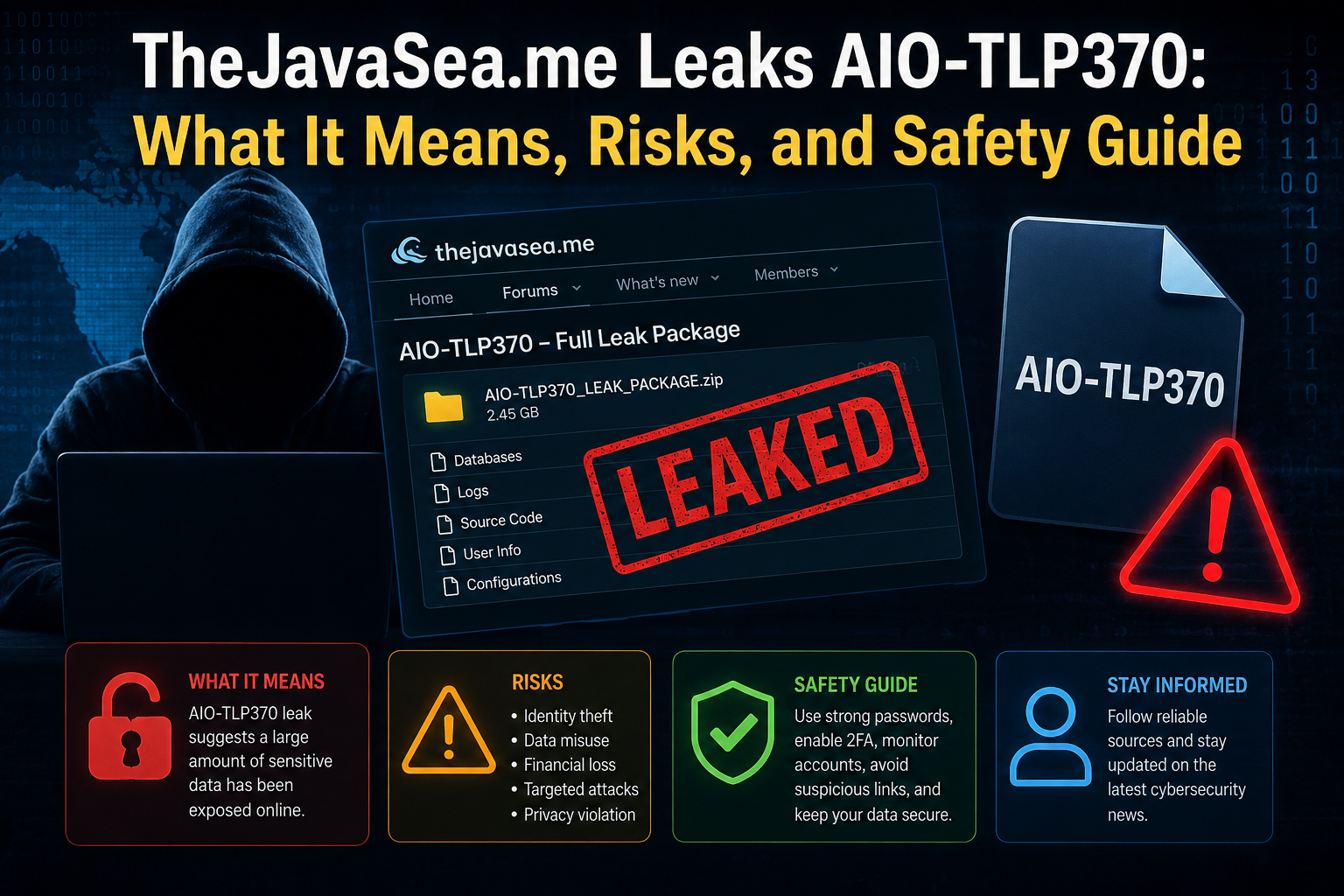
What Is TheJavaSea.me Leaks AIO-TLP370?
The phrase thejavasea.me leaks aio-tlp370 appears to combine several different elements:
- TheJavaSea.me — a domain or website name referenced in the keyword.
- Leaks — a term commonly used online for allegedly exposed, shared, or redistributed information.
- AIO-TLP370 — an unusual identifier that may represent a file label, archive name, collection reference, internal code, or another type of online identifier.
The important point is that the exact meaning of AIO-TLP370 cannot be established simply from the keyword itself.
Online communities often create names for files, collections, archives, or posts. Those names may later appear in search engines, social media discussions, forums, or cybersecurity conversations. As a result, a keyword can continue circulating even when its original context is unclear.
Therefore, anyone researching thejavasea.me leaks aio-tlp370 should avoid treating the keyword as automatic proof of a verified cybersecurity incident.
Why Is the Keyword TheJavaSea.me Leaks AIO-TLP370 Getting Attention?
There are several reasons why unusual leak-related keywords can receive search interest.
1. Curiosity About Unknown Identifiers
AIO-TLP370 is not a normal phrase that immediately explains itself. When people see an unfamiliar code, they naturally want to know what it represents.
Search behavior often begins with a simple question:
“What is AIO-TLP370?”
People may then add terms such as “leaks,” “meaning,” “download,” or the name of a website. This can create a growing collection of searches around the same keyword.
2. Search Engine Discovery
Unusual combinations of words can become visible through search engines. Once several pages mention the same phrase, users may discover it through related searches.
This does not necessarily mean the underlying information is reliable.
Search visibility and factual verification are two different things.
3. Online Discussions
Cybersecurity-related topics often spread through forums, social media, messaging platforms, and technology communities. A single claim can be copied across multiple websites.
After being repeated many times, an unverified statement can appear authoritative even when the original evidence is missing.
4. Curiosity Around Alleged Data Dumps
The word “leaks” attracts attention because people associate it with private information, databases, credentials, documents, or other sensitive material.
This makes keywords such as thejavasea.me leaks aio-tlp370 particularly likely to generate curiosity.
However, curiosity should always be balanced with caution.
Understanding the AIO-TLP370 Identifier
One of the most confusing parts of thejavasea.me leaks aio-tlp370 is the identifier “AIO-TLP370.”
There is no reliable universal meaning that can automatically be assigned to this string.
It could potentially be:
- A filename or archive label
- A collection identifier
- A forum-generated reference
- A project or internal code
- A search-oriented label
- A version or batch number
- An automatically generated identifier
- A term whose original context has been removed
The letters and numbers themselves are not enough to determine which explanation is correct.
Why Identifiers Can Be Misleading
A file or collection name can be changed easily. Someone may rename an archive before uploading or sharing it. Another person can copy the same name into a forum post. Search engines can then index the text.
This creates a chain where the identifier continues to appear even though users no longer have access to the original context.
For that reason, AIO-TLP370 should be treated as an identifier requiring verification rather than as proof of a particular event.
Read more about timewarp taskus
Does TheJavaSea.me Leaks AIO-TLP370 Confirm a Data Breach?
No.
The presence of the phrase thejavasea.me leaks aio-tlp370 in search results does not by itself confirm a legitimate data breach.
A confirmed cybersecurity incident normally requires evidence from reliable sources.
Depending on the incident, useful evidence could include:
- A statement from an affected organization
- A reputable cybersecurity research report
- A security advisory
- Technical evidence reviewed by security researchers
- Independent reporting from trustworthy publications
- Official notifications to affected users
- Evidence that can be independently verified
Without this type of evidence, it is safer to describe the matter as an alleged leak, unverified claim, or online reference rather than a confirmed breach.
Why You Should Be Careful With Alleged Leak Websites
Websites associated with alleged leaks can create several security risks.
The biggest danger is not necessarily the alleged information itself. The website, advertisement, download, or redirect surrounding the information may be designed to trick visitors.
Potential risks include:
Malware
Some suspicious pages may attempt to deliver malicious software through deceptive downloads or browser interactions.
Malware can potentially compromise devices, steal information, or interfere with normal computer operations.
Phishing
A suspicious page may imitate a login form, email service, social network, cloud platform, or other familiar service.
The objective may be to convince visitors to enter usernames, passwords, verification codes, or other private information.
Malicious Redirects
Some websites use multiple redirects that send visitors through unrelated pages.
These redirects can lead to scams, fake security warnings, fraudulent offers, or unsafe downloads.
Fake Files
A file advertised as a database, archive, report, or document may not contain what its name suggests.
It could instead be a malicious executable, a deceptive installer, or an unrelated file.
Privacy Exposure
Searching for or interacting with suspicious leak pages can expose information about your browsing activity.
This is another reason to avoid entering personal details on unknown websites.
The Difference Between a Data Leak and a Data Breach
The terms “data leak” and “data breach” are sometimes used interchangeably, but they can describe different situations.
A data breach generally refers to unauthorized access to protected information.
A data leak can refer more broadly to information becoming available to people who were not intended to access it.
For example, information could become exposed because of:
- Misconfigured cloud storage
- Poor access controls
- Accidental publication
- Compromised credentials
- Insider activity
- Vulnerable software
- Unauthorized system access
- Human error
Therefore, seeing the word “leak” does not automatically tell you how the information became exposed.
Potential Risks Associated With Alleged Leaks
If an alleged database or information collection contains genuine personal information, the consequences can be serious.
Identity Theft
Exposed personal information may potentially be used for impersonation or fraudulent activity.
Account Takeover
If passwords or authentication information are exposed, attackers may attempt to access related accounts.
Phishing Attacks
Leaked information can make scams more convincing.
For example, if someone knows a person’s name or an organization they interact with, a fraudulent message may appear more believable.
Spam
Exposed email addresses and phone numbers can lead to unwanted messages and calls.
Social Engineering
Attackers can combine publicly available information with exposed data to create targeted scams.
Reputation Damage
Sensitive information can sometimes be misused to harass, embarrass, or impersonate individuals.
How to Protect Yourself From Leak-Related Risks
Whether or not thejavasea.me leaks aio-tlp370 represents a genuine incident, basic cybersecurity practices can reduce your risk.
Use Strong, Unique Passwords
Avoid using the same password across multiple accounts.
If one service is compromised and the same password is used elsewhere, attackers may attempt to reuse it.
A better approach is to use a different strong password for every important account.
Enable Multi-Factor Authentication
Multi-factor authentication adds another layer of security beyond a password.
Depending on the service, the additional factor could involve an authentication application, security key, or another approved verification method.
Do Not Enter Credentials on Suspicious Pages
If a website unexpectedly asks you to sign in, stop and verify the address.
Instead of clicking a suspicious login link, open the official service through a trusted bookmark or manually navigate to its legitimate website.
Keep Software Updated
Operating systems, browsers, and applications should be updated regularly.
Security updates frequently address vulnerabilities that could otherwise be exploited.
Be Careful With Downloads
Do not download unknown files simply because their filenames claim to contain leaked information.
A filename does not prove what a file contains.
Watch for Phishing Messages
Be cautious if you suddenly receive messages claiming:
- Your account has been compromised
- Your password has expired
- Your payment failed
- You need to verify your identity
- Your device contains a virus
- You must download a security tool
These messages can be designed to create urgency and encourage unsafe decisions.
What Should You Do If You Think Your Information Was Exposed?
If you have a legitimate reason to believe that your information may have been compromised, take practical defensive steps.
Step 1: Change Important Passwords
Start with accounts that contain sensitive information.
Use new passwords that are not reused elsewhere.
Step 2: Turn On Multi-Factor Authentication
Enable MFA on important accounts whenever the service supports it.
Step 3: Review Account Activity
Check for:
- Unknown logins
- Unrecognized devices
- Unexpected password changes
- Strange account settings
- Unfamiliar transactions
Step 4: Contact the Relevant Organization
If the information relates to a company or service you use, contact that organization through its official website or support channel.
Do not rely on contact information supplied by an unknown leak-related page.
Step 5: Be Alert for Follow-Up Scams
After an alleged leak, criminals may exploit public anxiety.
You could receive fake messages claiming to offer:
- Account recovery
- Security verification
- Leak removal
- Password protection
- Refunds
- Technical support
Always verify such offers independently.
How to Verify Claims About TheJavaSea.me Leaks AIO-TLP370
One of the most important parts of researching thejavasea.me leaks aio-tlp370 is learning how to distinguish information from speculation.
Look for Independent Sources
If only one unknown website discusses a claim, confidence should remain low.
Independent sources provide stronger evidence when they reach similar conclusions using verifiable information.
Check the Date
Old information is sometimes presented as new.
Look at publication dates and determine whether the information is current.
Identify the Original Source
Ask:
Where did this claim originally come from?
If several websites simply copy each other, they may not represent independent confirmation.
Avoid Anonymous “Proof”
Screenshots, filenames, social media posts, and anonymous claims can be useful leads, but they are not automatically proof.
Look for Technical Evidence
Cybersecurity researchers often analyze incidents using technical indicators and other evidence.
Technical analysis is generally more useful than unsupported claims.
Common Myths About TheJavaSea.me Leaks AIO-TLP370
Myth 1: A Search Result Proves the Leak Is Real
It does not.
Search engines index content; they do not automatically verify every claim contained in that content.
Myth 2: A Strange Filename Proves It Contains Stolen Data
A filename can be created or changed by anyone.
The name alone does not establish authenticity.
Myth 3: Downloading a File Is the Best Way to Verify It
This is a risky assumption.
Unknown files can contain malicious software or other security threats.
Myth 4: If Many Websites Mention It, It Must Be True
Not necessarily.
Multiple websites can repeat the same original claim without independently verifying it.
Myth 5: Leak-Related Keywords Are Always Dangerous
The keyword itself is not necessarily harmful.
The risk comes from how people interact with suspicious websites, files, links, and claims associated with it.
Responsible Research Practices
If you are researching thejavasea.me leaks aio-tlp370 for cybersecurity, journalism, SEO, or general awareness, responsible research is important.
A safe research process should focus on publicly available information without attempting to access restricted, stolen, or private data.
Focus on Context
Ask what the keyword means, when it appeared, and why people are discussing it.
Compare Sources
Do not depend on one anonymous post.
Compare information from reputable cybersecurity publications, official statements, and established technology reporting.
Protect Your Device
Keep security software and operating systems updated while researching unfamiliar subjects.
Avoid Suspicious Downloads
You do not need to download questionable files to understand a cybersecurity topic.
Protect Other People’s Privacy
Even if information appears online, that does not mean it should be copied, republished, or distributed.
Privacy and responsible handling of information should remain priorities.
Why Privacy Matters in Leak Discussions
Data leak discussions often involve real people.
Behind every email address, username, phone number, or account identifier may be a real individual who never consented to the information being exposed.
Publishing or redistributing personal information can increase the damage caused by an original incident.
Responsible cybersecurity writing should therefore focus on:
- Awareness
- Prevention
- Verification
- Risk reduction
- Privacy
- Defensive security
It should not encourage the redistribution of sensitive personal information.
The Role of Search Engines in Leak-Related Topics
Search engines play an important role in how unusual keywords become popular.
When users repeatedly search for a phrase, more pages may begin targeting that phrase. This can create a feedback loop:
- Someone publishes a claim.
- Users search for the claim.
- Other websites notice the search interest.
- More pages mention the keyword.
- Search volume increases.
- Even more users discover the keyword.
This process can make an obscure phrase appear much more significant than it originally was.
Therefore, search volume should never be confused with evidence.
SEO Perspective on TheJavaSea.me Leaks AIO-TLP370
From an SEO perspective, thejavasea.me leaks aio-tlp370 is an unusual long-tail keyword.
Long-tail keywords often have several characteristics:
- They contain multiple words.
- They may have limited search volume.
- Search intent can be unclear.
- Competition can be lower than broad keywords.
- Users may be looking for very specific information.
However, responsible SEO requires more than repeating the keyword.
Keyword stuffing can reduce readability and may create a poor user experience.
A better SEO strategy is to naturally cover related search intent, including:
- TheJavaSea.me meaning
- AIO-TLP370 meaning
- Alleged leak explanation
- Online privacy risks
- Data breach awareness
- Cybersecurity safety
- How to verify online claims
- Protecting personal information
This approach creates useful content rather than simply repeating the same phrase.
How to Use the Keyword Naturally
For an article targeting thejavasea.me leaks aio-tlp370, the keyword can appear naturally in strategic locations.
For example:
- SEO title
- Introduction
- One or two relevant headings
- Main body
- FAQ section
- Conclusion
- Meta description
The keyword should not be forced into every paragraph.
Good SEO writing prioritizes relevance and readability.
Frequently Asked Questions
What does thejavasea.me leaks aio-tlp370 mean?
The phrase appears to reference TheJavaSea.me, alleged leaks, and an identifier called AIO-TLP370. The exact meaning of AIO-TLP370 cannot be established from the keyword alone, so claims about its contents should be treated cautiously unless independently verified.
Is AIO-TLP370 a confirmed database leak?
The identifier itself does not prove that a database leak exists. Confirmation requires reliable evidence from trustworthy and independent sources.
Is TheJavaSea.me safe to visit?
Users should be cautious with unfamiliar websites associated with alleged leaks. Avoid suspicious downloads, login forms, redirects, and requests for personal information.
Should I download an alleged AIO-TLP370 file?
It is not advisable to download unknown files simply to investigate an alleged leak. Unknown downloads can create cybersecurity and privacy risks.
Can leaked information be used for phishing?
Yes. If genuine personal information becomes exposed, criminals may potentially use it to make phishing or social-engineering attempts more convincing.
How can I protect my accounts?
Use unique passwords, enable multi-factor authentication, keep software updated, review account activity, and remain cautious about unexpected messages and links.
Does Google verify leak claims?
Search engines index and rank web content, but the appearance of a claim in search results does not automatically mean that the claim has been independently verified.
Why are unusual leak keywords popular?
Curiosity, social media discussions, search trends, copied articles, and online speculation can all contribute to the popularity of unusual keywords.
What should I do if I think my information was exposed?
Change affected passwords, enable multi-factor authentication, review account activity, contact the relevant organization through official channels, and watch for phishing attempts.
Final Thoughts on TheJavaSea.me Leaks AIO-TLP370
The keyword thejavasea.me leaks aio-tlp370 represents the kind of unusual internet search term that can generate significant curiosity while still leaving important questions unanswered.
The name AIO-TLP370 does not, by itself, establish what a file, collection, or alleged leak contains. Similarly, the appearance of a website name alongside the word “leaks” should not automatically be interpreted as confirmation of a real cybersecurity incident.
The safest approach is to separate search interest from verified information.
If you encounter claims about thejavasea.me leaks aio-tlp370, examine the source, look for independent confirmation, check dates, avoid suspicious downloads, and never provide passwords or personal information to unknown websites.
From a cybersecurity perspective, prevention is more valuable than curiosity. Strong passwords, multi-factor authentication, software updates, careful browsing, and awareness of phishing can significantly improve online security.
Most importantly, responsible research should protect people’s privacy rather than contribute to the spread of potentially sensitive information.
In short, thejavasea.me leaks aio-tlp370 should be approached as an online keyword requiring context and verification—not as automatic proof of a confirmed leak. Until reliable evidence establishes the facts, readers should remain cautious, protect their accounts, and rely on trustworthy cybersecurity information rather than anonymous claims or suspicious downloads.