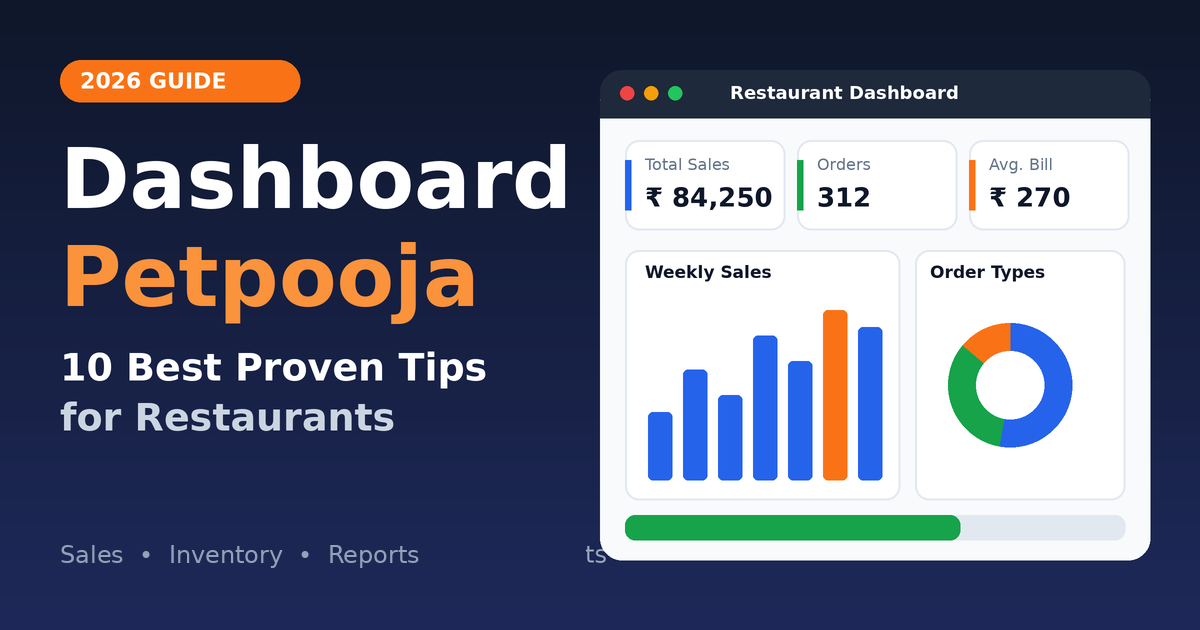
The dashboard Petpooja is the web-based and mobile-accessible management panel connected to the Petpooja restaurant software. Every bill printed at the counter, every kitchen order token, every online order received and every stock item consumed is recorded by the system and then displayed on the dashboard in an organised format. Instead of waiting for end-of-day paper summaries or calling the manager to ask how the shift went, an owner can simply log in and see sales, taxes, discounts and payment modes within seconds.
The idea behind the dashboard Petpooja is simple: data should work for the restaurant, not the other way around. Many small businesses collect huge amounts of information but never convert it into action. A well-designed dashboard solves that problem by turning raw transactions into charts, summaries and comparisons that a non-technical person can understand without any special training.
Why Restaurant Owners Need the Dashboard Petpooja
Before software became common, restaurant owners relied on handwritten registers, memory and trust. Mistakes were frequent, theft was difficult to detect and decisions were often based on guesses. A modern dashboard changes this culture completely. Because each transaction is time-stamped and linked to a user, accountability improves naturally. Staff members know that discounts, cancelled bills and complimentary items are recorded, which reduces misuse.
Beyond security, a dashboard gives clarity about profitability. Many owners are surprised to learn that their best-selling dish is not their most profitable one. When you study item-wise sales alongside costs, you can promote high-margin items and rethink slow movers. The dashboard Petpooja supports this style of thinking by presenting sales data in a way that encourages comparison across days, weeks, months and outlets.
Key Features Available on the Dashboard Petpooja
The dashboard brings together information from several modules of the software. Sales summary is usually the first thing a user notices, showing total revenue, number of orders, average order value and tax collected for a chosen period. Alongside it, payment-mode breakdowns show how much money arrived through cash, cards, UPI and wallets, which makes daily cash reconciliation far easier at closing time.
Order-type analysis is another valuable section. Restaurants today earn from dine-in, takeaway and delivery channels at the same time, and each channel carries different costs and commissions. By looking at how revenue splits across these channels, an owner can decide where to invest marketing effort. Item-wise and category-wise reports reveal which menu entries drive revenue, while discount and cancellation reports highlight possible leakages. Inventory alerts, purchase summaries and wastage records complete the picture, so that nothing important remains hidden in the back office.
How the Dashboard Petpooja Handles Sales Reporting
Sales reporting is the heart of any restaurant dashboard, and this is where the dashboard Petpooja is used most frequently by owners and managers. Owners can filter results by date range, outlet, order type or even individual cashier. A manager reviewing the lunch rush, for example, can compare it with the same time last week and immediately see whether footfall has improved or declined.
Day-wise and hour-wise sales views are especially useful for staff planning. If the data shows that Tuesday afternoons are consistently slow while Friday evenings overflow, the owner can schedule fewer employees on quiet days and add extra hands during peak hours. This directly reduces labour cost without hurting service quality. Tax summaries are also generated automatically, which saves accountants a great deal of manual effort during monthly return filing and helps maintain accurate records for compliance purposes.

Inventory and Food Cost Control Through the Dashboard Petpooja
Food cost is usually the largest expense in a restaurant, and even a small improvement in control can raise net profit noticeably. The inventory management features connected to the dashboard Petpooja help track raw materials from purchase to consumption. When a dish is sold, the system can deduct the required quantity of ingredients according to its recipe, giving a theoretical stock figure that can be compared with the physical count.
Any gap between the two numbers signals wastage, over-portioning, spoilage or theft. Instead of discovering the problem months later, the owner sees it within days and can take corrective action. Low-stock alerts prevent the embarrassing situation of running out of a popular ingredient during dinner service, while purchase reports help negotiate better rates with suppliers by showing exactly how much you buy and how often.
Managing Multiple Outlets with the Dashboard Petpooja
For growing brands, one of the biggest challenges is maintaining consistency across locations. A chain owner cannot physically be present in every kitchen, so reliable remote visibility becomes essential. The dashboard Petpooja allows centralised monitoring, where results from every outlet can be viewed together or separately, depending on the need.
Menu changes, price updates and tax settings can often be controlled from the head office and then pushed to all branches, which keeps the customer experience uniform. Comparing outlet performance also encourages healthy internal competition. If one branch consistently achieves higher average order value, the management can study its practices, such as upselling methods or combo offers, and share them with the others.
Online Order Integration and Delivery Insights
Online food delivery has become a major revenue source for Indian restaurants, but it also brings complexity. Orders arrive from different aggregator platforms and from the restaurant’s own ordering channels, each with separate commissions, packaging charges and timelines. Petpooja supports integrations with popular delivery platforms, and the data from these orders flows into the same system that records dine-in sales.
As a result, the dashboard lets restaurant owners see delivery performance next to in-house performance without switching between multiple tablets and apps. Owners can check how many orders were accepted, how many were rejected or delayed and how much revenue each channel contributed. This transparency helps in negotiating with platforms, adjusting menu prices for delivery, and deciding whether a particular channel is actually profitable after commissions are deducted.
Integration availability may vary by platform and plan, so it is wise to confirm details on the official Petpooja website at https://www.petpooja.com before making a purchase decision.
Customer Data and Loyalty Insights
Repeat customers are the backbone of a stable restaurant business, because acquiring a new guest is generally more expensive than retaining an existing one. When customer details are captured during billing, the system can build a record of visit frequency, favourite items and spending habits. The dashboard can surface this information so that owners understand who their loyal guests are and what they prefer.
With this knowledge, simple but effective marketing becomes possible. A cafe may send a birthday offer, a family restaurant may invite lapsed customers back with a special discount, and a fast-food outlet may reward frequent buyers with points. Such targeted actions usually perform better than generic advertising because they feel personal. Businesses must handle customer information responsibly and respect privacy expectations, using it only for legitimate service and communication purposes.
Read more about: giftogram
Using the Mobile Dashboard Petpooja for On-the-Go Control
Restaurant owners rarely sit behind a desk. They visit suppliers, attend events, travel to new locations and sometimes simply take a day off. Mobile phone access to the dashboard means business visibility does not stop when the owner leaves the premises. A quick glance at the phone can confirm that sales are on track, that no unusual discounts were given and that the day has closed properly.
This convenience also improves decision speed. If an owner notices that a promotional offer is bringing unexpectedly large volumes, kitchen preparation can be adjusted immediately. If a particular item sells out early, a reminder to purchase more can be sent without delay. Real-time information turns management from reactive to proactive, which is especially valuable in a business where freshness and timing directly influence customer satisfaction.
Best Practices to Get the Most from the Dashboard Petpooja
Software such as this dashboard is only as useful as the discipline of the people using it. The first best practice is accurate data entry. Menu items should be named clearly, prices should be updated promptly and every sale should be billed through the system. If staff bypass the software for certain orders, the dashboard will present an incomplete picture and lead to wrong conclusions.
The second practice is to build a regular review habit. Many successful owners check the dashboard at the end of every day, review detailed reports weekly and carry out a deeper analysis monthly. Daily checks catch operational issues, weekly reviews reveal short-term trends and monthly studies guide strategic decisions such as menu redesign or pricing changes. Training staff to understand why accurate records matter also strengthens the overall culture of accountability within the team.
The third practice is to act on the numbers. A report that nobody reads or applies has no value. When the dashboard shows a high cancellation rate, investigate the cause. When it shows a slow category, test a new recipe or promotion.
Compliance and Record Keeping with Dashboard Petpooja
Indian restaurants must follow several regulatory requirements, including tax rules and food safety standards. Accurate billing records make compliance much easier, and the dashboard Petpooja helps by storing detailed transaction histories and generating tax-related summaries that accountants can use. Owners should always confirm the latest tax rates and filing rules with a qualified professional, since regulations change from time to time.
Food safety licensing and hygiene standards are also an important part of running a legitimate restaurant. The Food Safety and Standards Authority of India publishes official guidance for food businesses on its website at https://www.fssai.gov.in, and every owner should be familiar with it. While a dashboard cannot replace licences or inspections, orderly digital records show professionalism and make audits less stressful.
Common Dashboard Petpooja Mistakes Owners Should Avoid
One common mistake is looking only at total sales. Revenue alone can be misleading, because a restaurant may sell more while earning less if costs and discounts are rising faster. The dashboard Petpooja should be used to study margins, wastage and discounts together, not just the headline figure.
Another mistake is ignoring small anomalies. A slightly higher number of voided bills or an unexplained drop in stock may seem harmless, yet repeated patterns often indicate larger problems. Finally, some owners adopt the software but never train their team properly, which results in errors, frustration and underuse of features. Investing a little time in onboarding pays back many times over.
Choosing the Right Plan for Your Dashboard Petpooja
Every restaurant has different needs, so it is sensible to evaluate which modules are truly necessary before subscribing. A small takeaway shop may only need billing and basic reports, while a large dine-in brand will benefit from inventory, multi-outlet control and customer management. Ask for a demonstration, check hardware compatibility and understand the support options available, since reliable assistance during busy hours can be as important as the software itself.
Training Your Team to Use the Dashboard Petpooja
A dashboard delivers value only when the whole team understands the purpose behind it. Cashiers should know why every order must be punched into the system, captains should understand how table service affects reports, and managers should learn how to read trends confidently. Short training sessions, supported by simple written instructions, make adoption smoother.
When employees see that the dashboard Petpooja rewards accurate work with fair performance tracking, resistance usually fades and the entire operation becomes more disciplined and transparent, which ultimately benefits every guest who walks in.
Conclusion: Dashboard Petpooja in Short
The dashboard Petpooja gives restaurant owners a clear, organised and timely view of their business, covering sales, inventory, online orders, customers and multiple outlets. When used consistently and with accurate data, it supports smarter decisions, tighter cost control and steadier growth. Review the numbers regularly each week and let the insights guide your next business move.